Quaternions for ROS Developers: What x, y, z, w Actually Mean
Read the post →
Robotics · October 2026
Convert orientations the way ROS does, and stop guessing axis orders.
 By pankaj · 0 robots
About
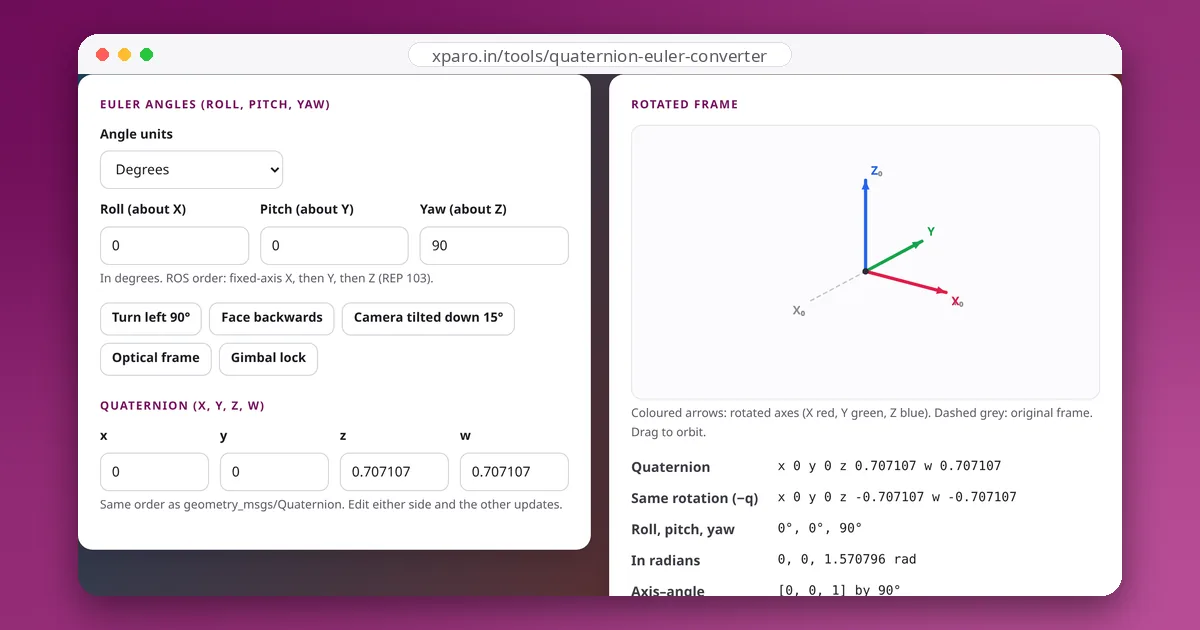
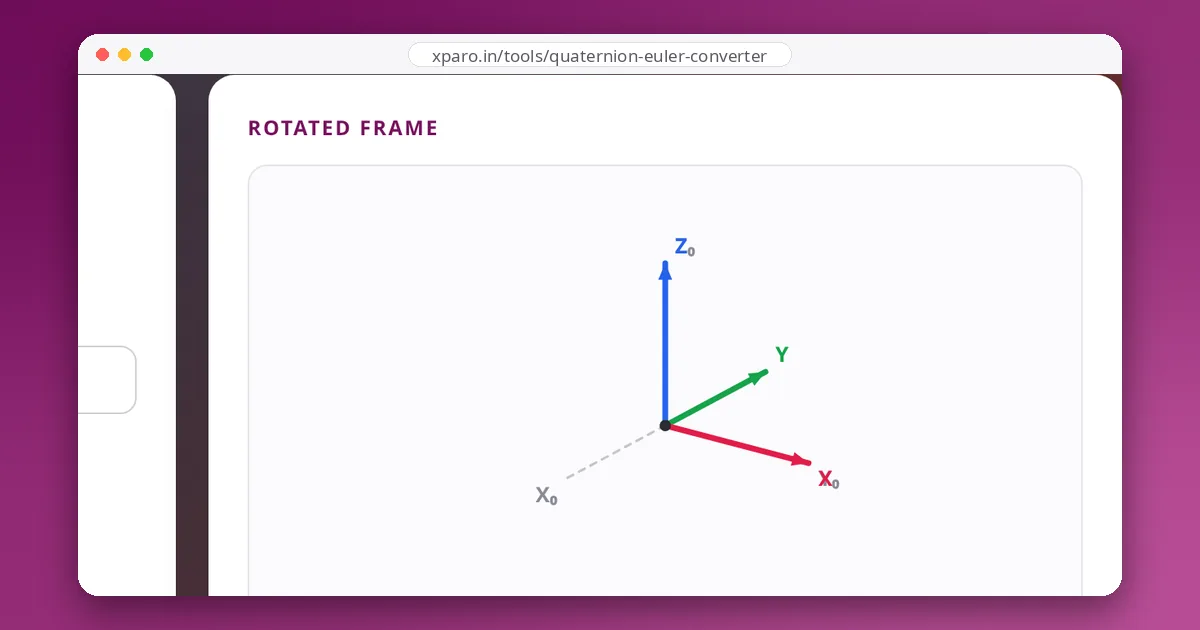
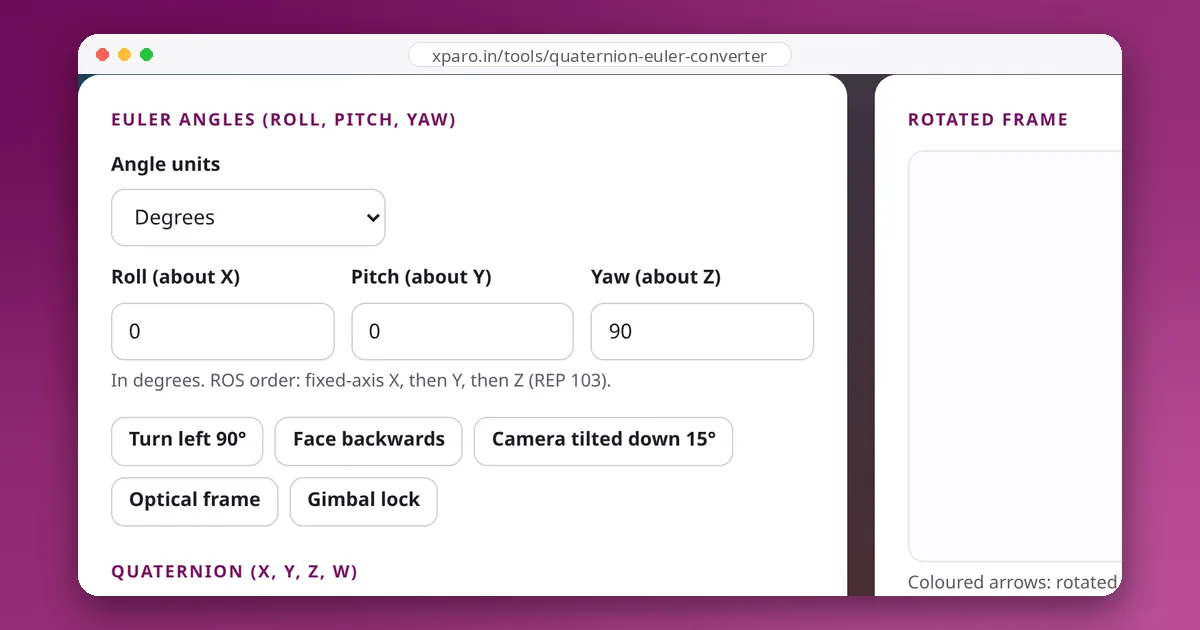
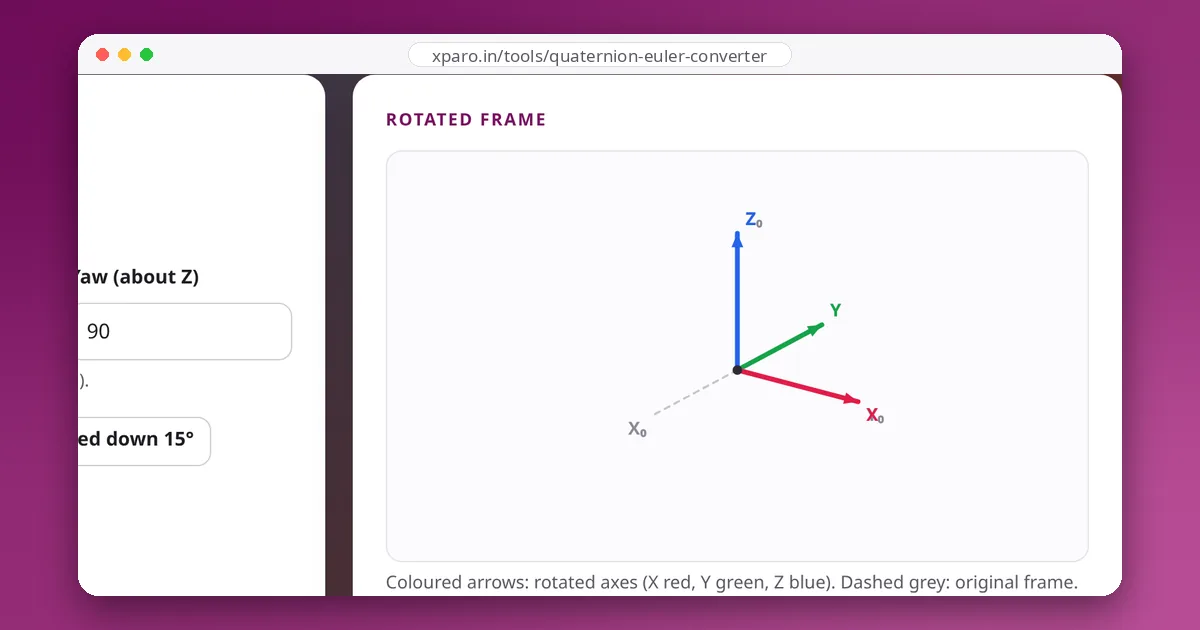
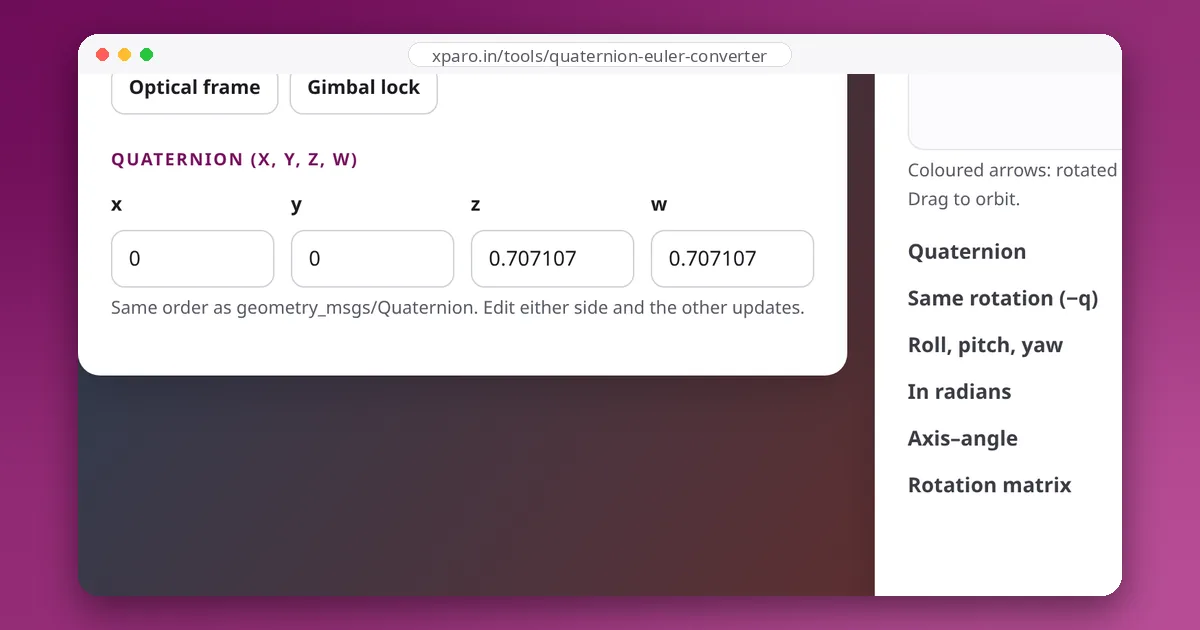
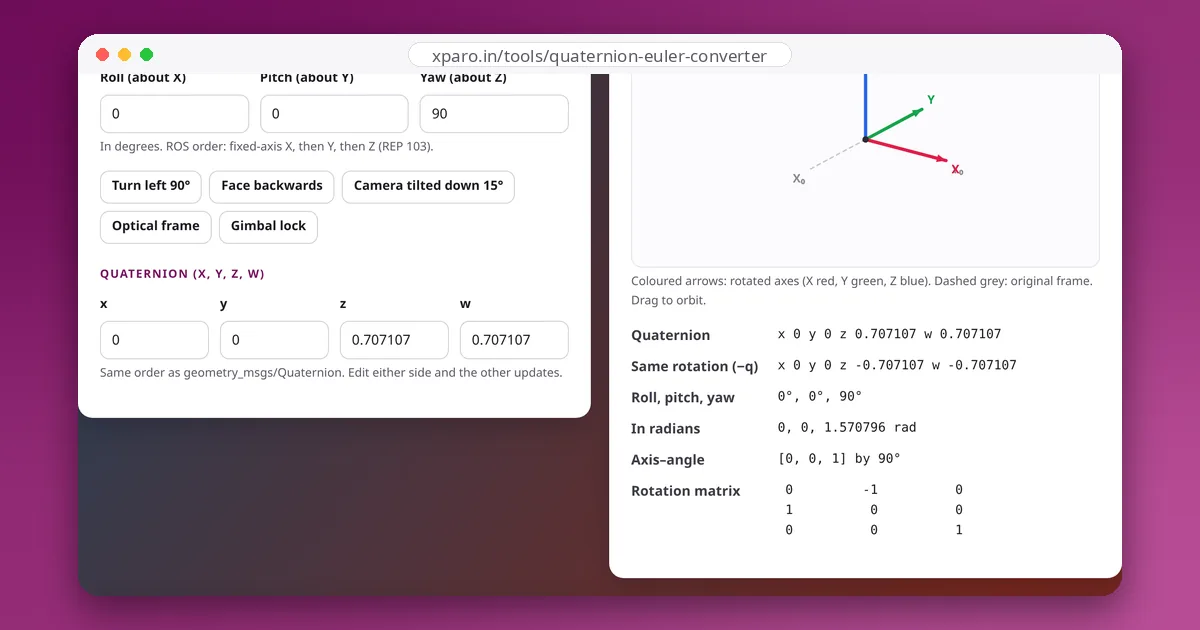
Orientation is where many ROS bugs hide. A sensor mounted upside down, a camera frame pointing the wrong way, a quaternion copied with its components in the wrong order: all of these produce robots that are confidently wrong. The Quaternion ↔ Euler Converter makes orientations easy to check.
static_transform_publisher commands, a URDF joint, a message snippet, and Python and C++ code.We compare the converter with SciPy's rotation module and ROS's own tf_transformations package on thousands of random orientations, including the gimbal-lock cases. The results agree to about 10−13 radians.
Open the Quaternion ↔ Euler Converter. The guides below explain quaternions, the ROS axis conventions, gimbal lock, conversion code in Python and C++, and static transforms for sensors.
Gallery
Team
The team that builds, runs and answers for this project on XPARO.
Updates
Read the post →
Read the post →
Read the post →
Read the post →
Read the post →
FAQ
The ROS convention from REP 103: roll about X, pitch about Y and yaw about Z, applied as fixed-axis X then Y then Z rotations, which equals intrinsic Z-Y'-X'' rotations. Quaternions are written x, y, z, w like geometry_msgs.
Yes. The results match tf2's Quaternion::setRPY and getRPY and the Python quaternion_from_euler and euler_from_quaternion functions.
Yes, and it runs entirely in your browser.
Contact
Questions, ideas, or want to work with the team? Your message goes straight to the Quaternion ↔ Euler Converter team on XPARO. Add your email if you'd like a reply.