A DC motor datasheet is a page of numbers that all describe one simple straight line. Once you see that line, choosing a motor and a gear ratio becomes straightforward. This guide explains the key datasheet terms with a consistent worked example, shows how a gearbox changes them, and gives a method for picking the ratio.
The example motor
A small 24 V brushed motor, the kind found inside many robot gearmotors:
| Datasheet term | Value | Meaning |
|---|---|---|
| Rated voltage | 24 V | The voltage all other figures refer to. |
| No-load speed | 6000 RPM | Speed with nothing attached. The motor never reaches it under load. |
| No-load current | 0.3 A | Current needed just to overcome internal friction. |
| Stall torque | 0.5 N·m | Torque with the shaft held still. The maximum, briefly. |
| Stall current | 13.4 A | Current at stall: the most the motor draws and what drivers and fuses must survive. |
| Speed constant Kv | 250 RPM/V | No-load speed per volt (6000 ÷ 24). |
| Torque constant Kt | 0.0382 N·m/A | Torque per amp. For an ideal motor, Kt = 60 ÷ (2π × Kv). |
| Rated torque | 0.1 N·m | The torque the motor can deliver continuously without overheating. |
The straight line
For a brushed DC motor at a fixed voltage, speed falls linearly with load, and current rises linearly:
For our motor, that gives:
| Load torque | Speed | Current | Output power | Efficiency |
|---|---|---|---|---|
| 0.05 N·m | 5400 RPM | 1.6 A | 28 W | 73 % |
| 0.065 N·m | 5220 RPM | 2.0 A | 36 W | 74 % (maximum) |
| 0.10 N·m (rated) | 4800 RPM | 2.9 A | 50 W | 72 % |
| 0.25 N·m (half stall) | 3000 RPM | 6.8 A | 79 W (maximum) | 48 % |
Three facts fall out of this table:
- Maximum efficiency is at light load, here about 13 % of stall torque. A motor run near its best-efficiency point uses the least battery and stays cool.
- Maximum power is at half the stall torque and half the no-load speed, but at less than 50 % efficiency, so half the electrical power becomes heat. Fine for a short burst, not for continuous running.
- The rated torque is a thermal limit, usually well below the maximum-power point. It is the number to compare with your continuous torque requirement.
Changing the supply voltage shifts the whole line: no-load speed and stall torque both scale with voltage. A battery that sags under load moves the line inward exactly when you need it most.
What a gearbox does
Behind a 30:1 gearbox with 80 % efficiency, our motor becomes a gearmotor with a no-load speed of 200 RPM and a stall torque of 0.5 × 30 × 0.8 = 12 N·m. Gearbox efficiency varies with design: roughly 90 to 95 % per spur or planetary stage (so multi-stage boxes lose more), and much less for worm gears, which in exchange often cannot be back-driven.
Check the gearbox's own torque rating. A gearbox is often rated for less than the motor's stall torque times the ratio; stalling the motor can then strip the gear teeth. The gearbox rating, not the motor, may be the real limit.
Choosing a gear ratio
For a wheeled robot, a practical method is:
- Find the wheel speed at top speed. For 1.5 m/s on 200 mm wheels, that is 143 RPM.
- Aim for that speed to be around 70 to 80 % of the geared no-load speed, so the motor keeps some speed in hand under load. 143 ÷ 0.75 ≈ 191 RPM.
- Ratio ≈ motor no-load speed ÷ that figure: 6000 ÷ 191 ≈ 31, so a standard 30:1 gearbox.
- Check torque: the geared rated torque (0.1 × 30 × 0.8 = 2.4 N·m) must cover your continuous requirement, and the geared line must still give enough speed at your peak torque.
For the 45 kg robot in our motor sizing guide, cruising on the flat needs 0.62 N·m at 143 RPM; this gearmotor manages 190 RPM at that load. Climbing the 6° ramp at half speed needs 4.94 N·m at 72 RPM; the line gives 118 RPM, so it works, as a short-term load well above the 2.4 N·m rating.
A higher ratio gives more torque and less speed; a lower ratio the reverse. If no ratio satisfies both your top speed and your torque, the motor is too small: no gearbox can create power the motor does not have.
Reading datasheets critically
- Check which shaft the figures refer to: the motor's or the gearbox output.
- Check the voltage the figures were measured at; scale them if your battery differs.
- Treat stall torque as a limit, not a working point. Hobby listings sometimes headline it as if the motor could deliver it continuously.
- Look for thermal data: the continuous rating, and how long the motor can exceed it.
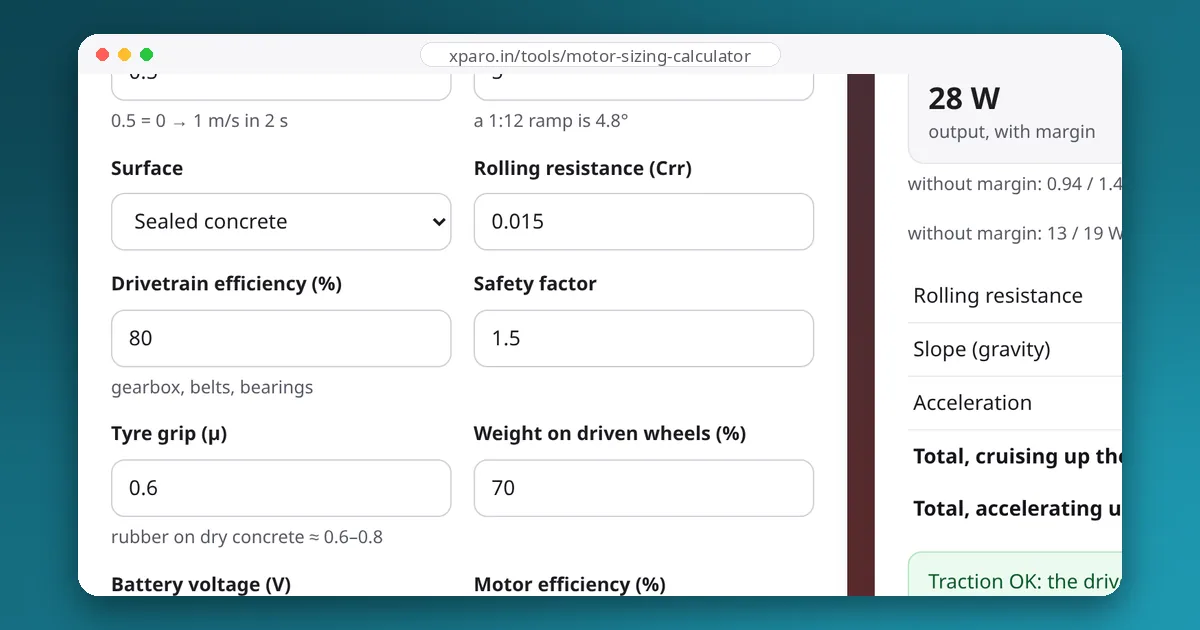
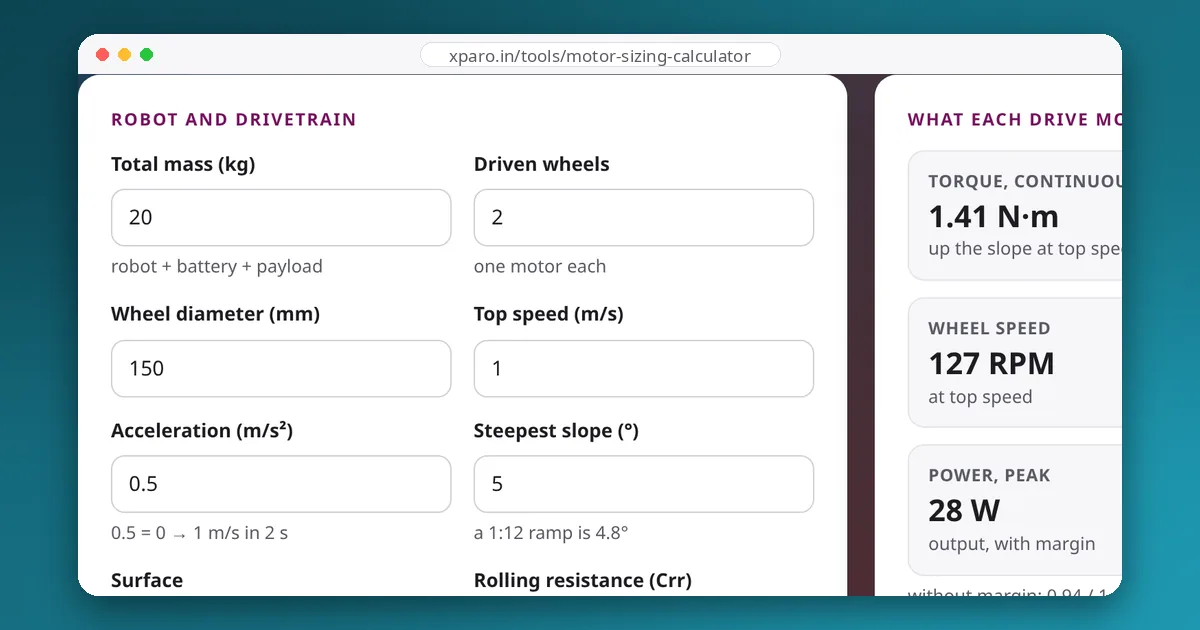
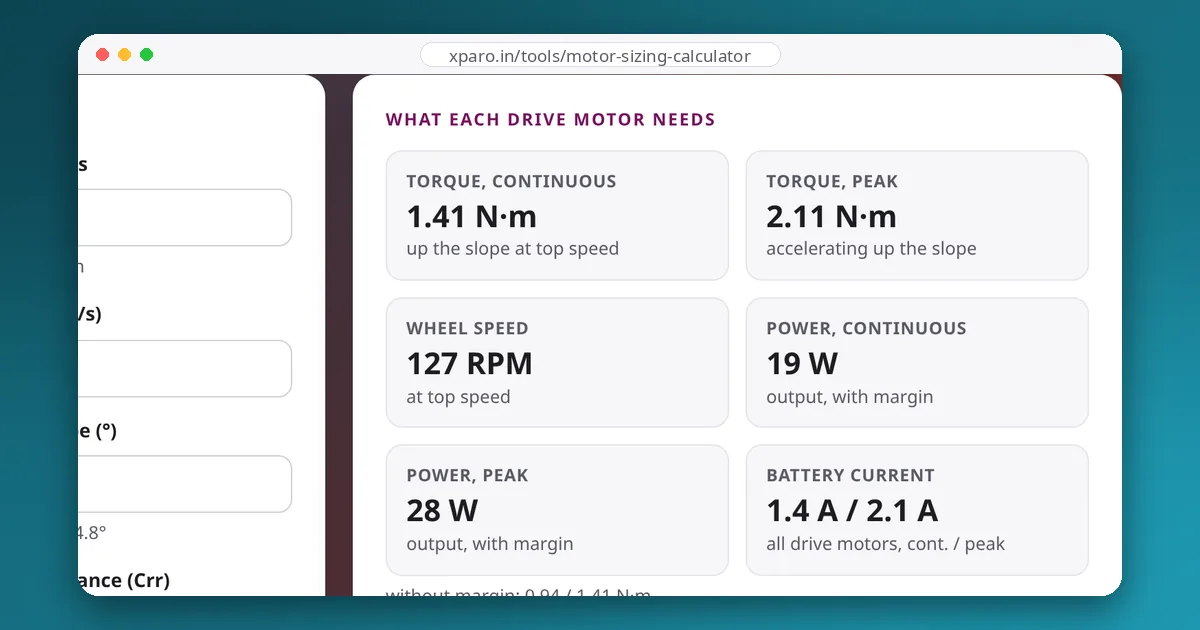
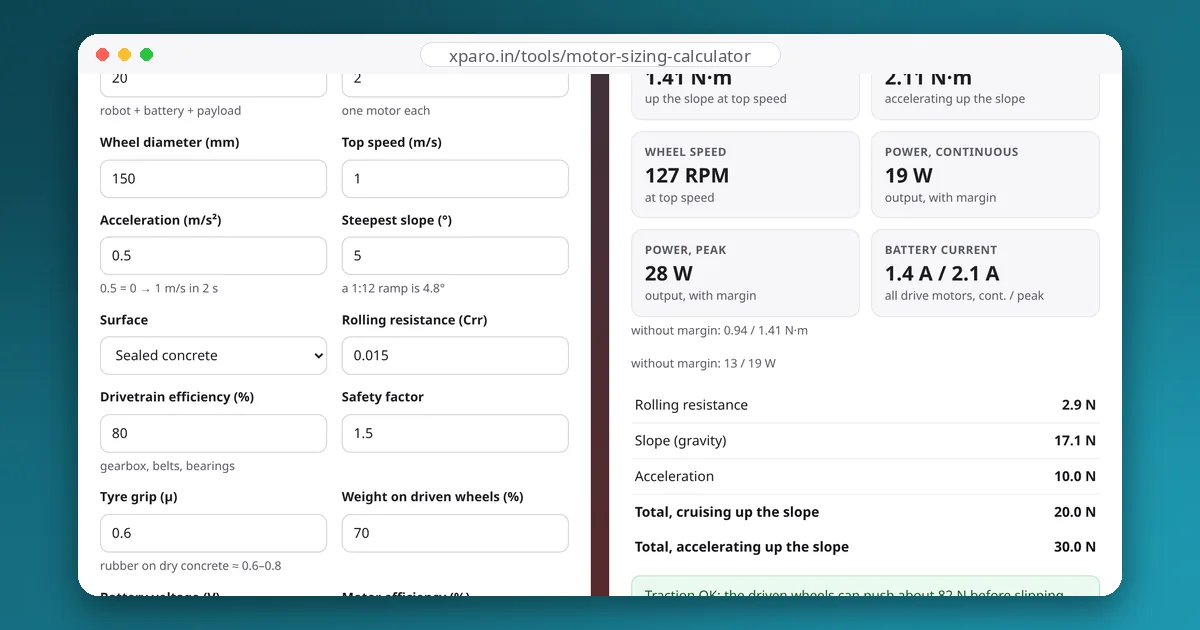
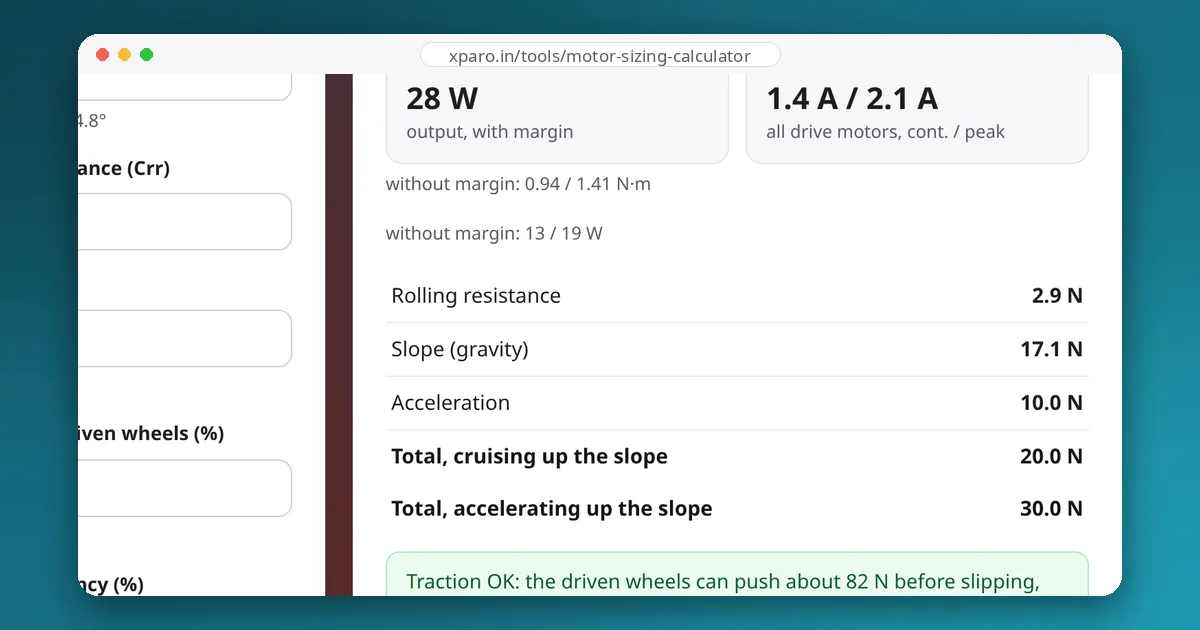
The Motor & Wheel Sizing Calculator accepts no-load speed, stall torque and rated torque, at the output or for a bare motor with a gear ratio, and plots the line against your requirements.