How to use the motor sizing calculator
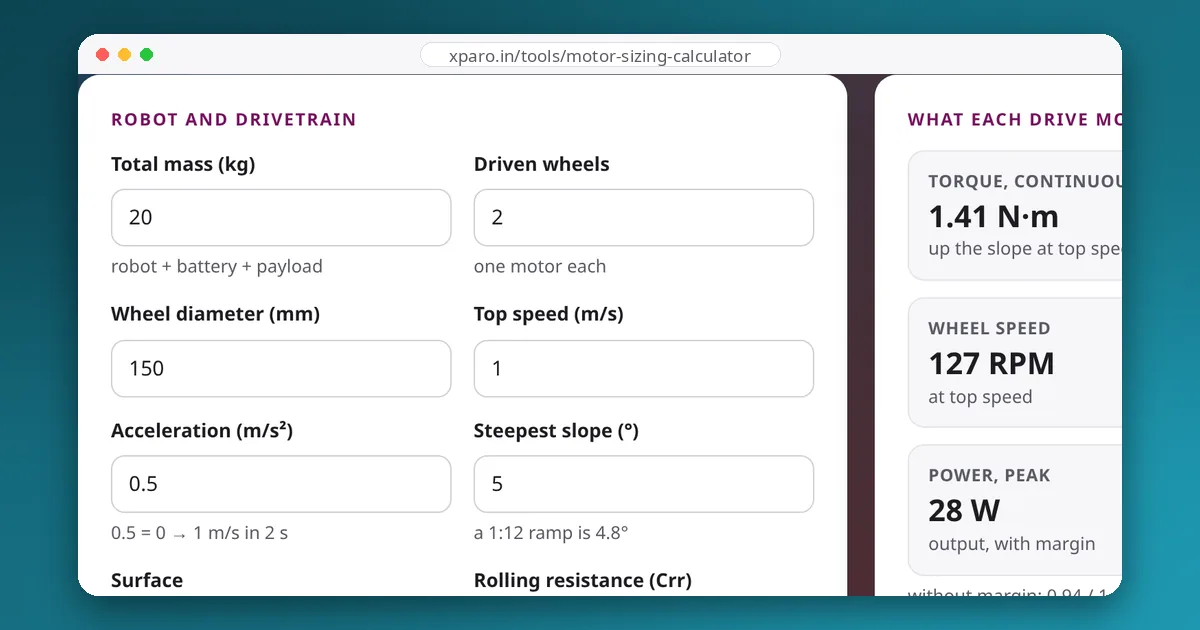
- Describe the robot. Enter the total mass including battery and payload, the number of driven wheels (one motor each), the wheel diameter, top speed and the acceleration you want.
- Describe the worst conditions. Enter the steepest slope and pick the roughest surface the robot must handle. Motors are sized for the worst case, not the average.
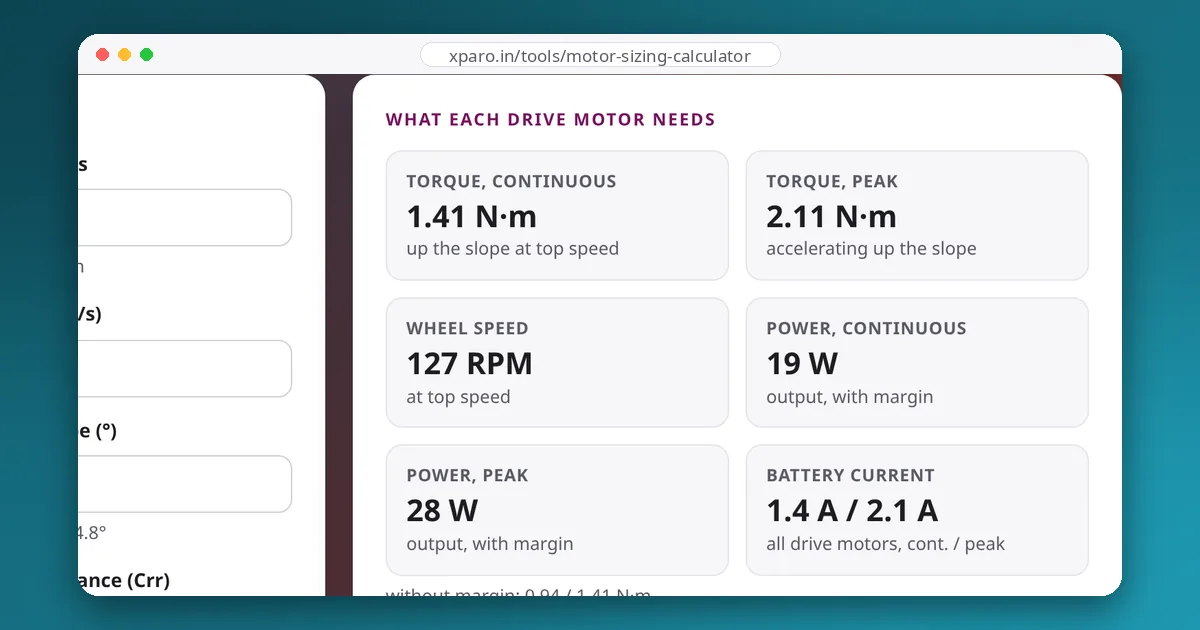
- Read the requirement. You get the torque each motor must deliver continuously and at peak, the wheel speed, the power and the battery current. All torques include your safety factor.
- Check a real motor. Enter a datasheet's no-load speed, stall torque and rated torque. The chart plots its torque-speed line against your operating points: both dots must sit under the line, and the green one below the rated torque.
The physics in four lines
Rolling resistance F_roll = Crr × m × g × cos θ
Slope F_slope = m × g × sin θ
Acceleration F_acc = m × a
Torque per motor T = (F_total ÷ n) × r ÷ η × safety factor
Wheel speed (RPM) N = v ÷ (π × D) × 60
Continuous torque uses the force to cruise up the slope at top speed; peak torque adds the acceleration force. Power is torque times wheel speed (in rad/s), which is the mechanical output each motor must deliver.
Worked example
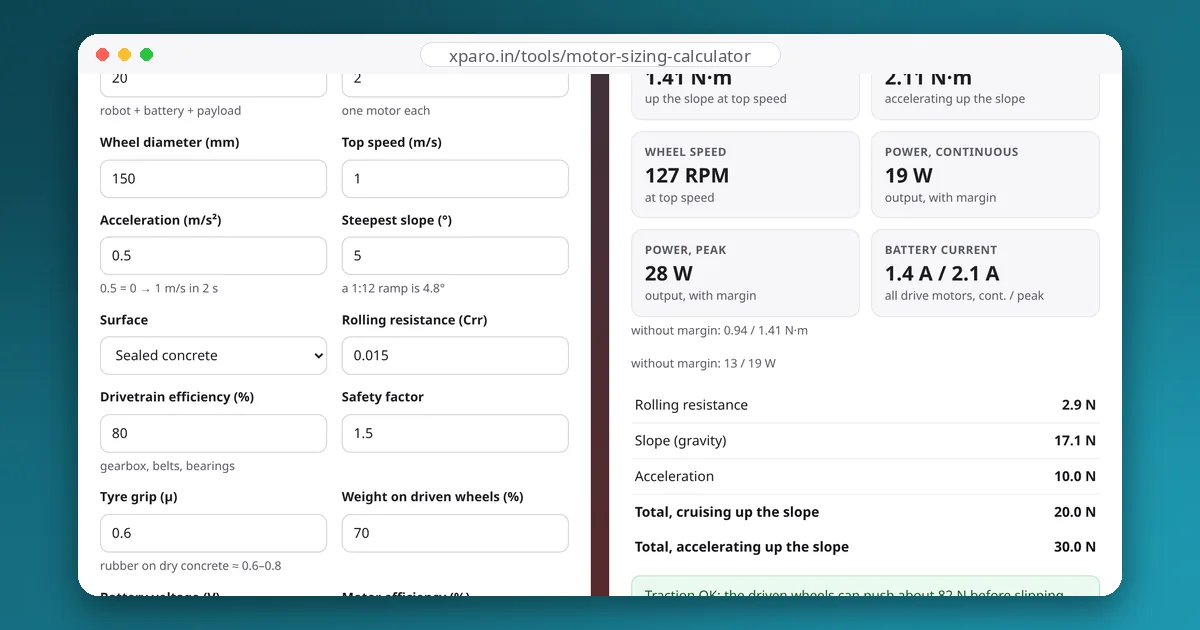
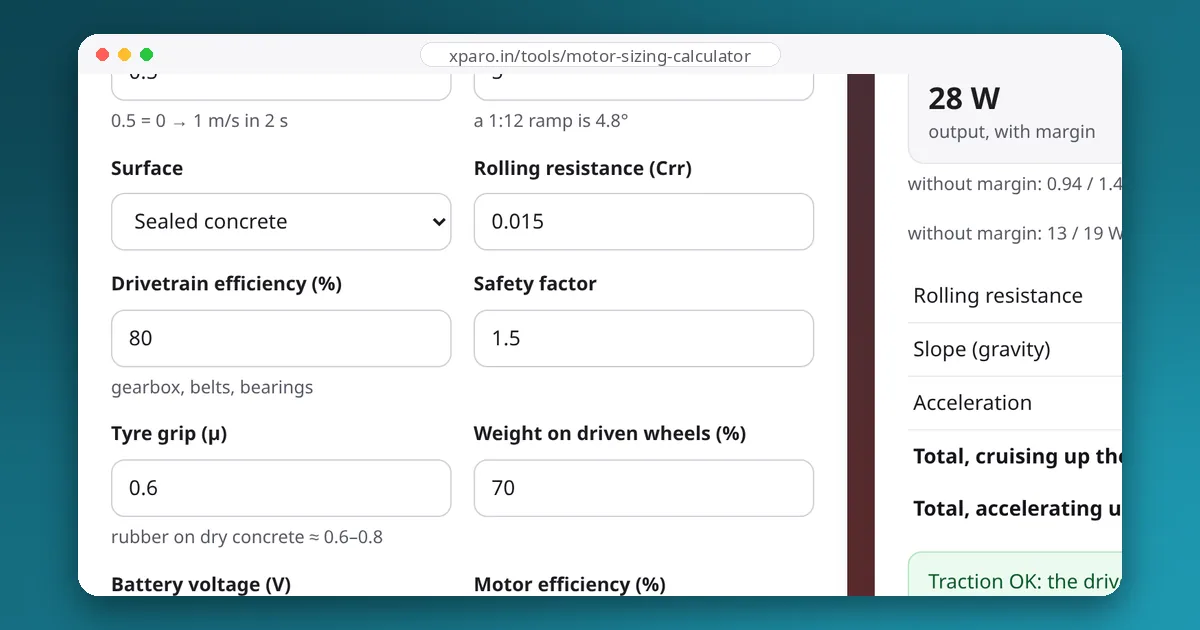
The calculator opens with a 20 kg indoor robot on two 150 mm wheels, aiming for 1 m/s, 0.5 m/s² and a 5° ramp on sealed concrete (Crr 0.015), with 80 % drivetrain efficiency and a safety factor of 1.5.
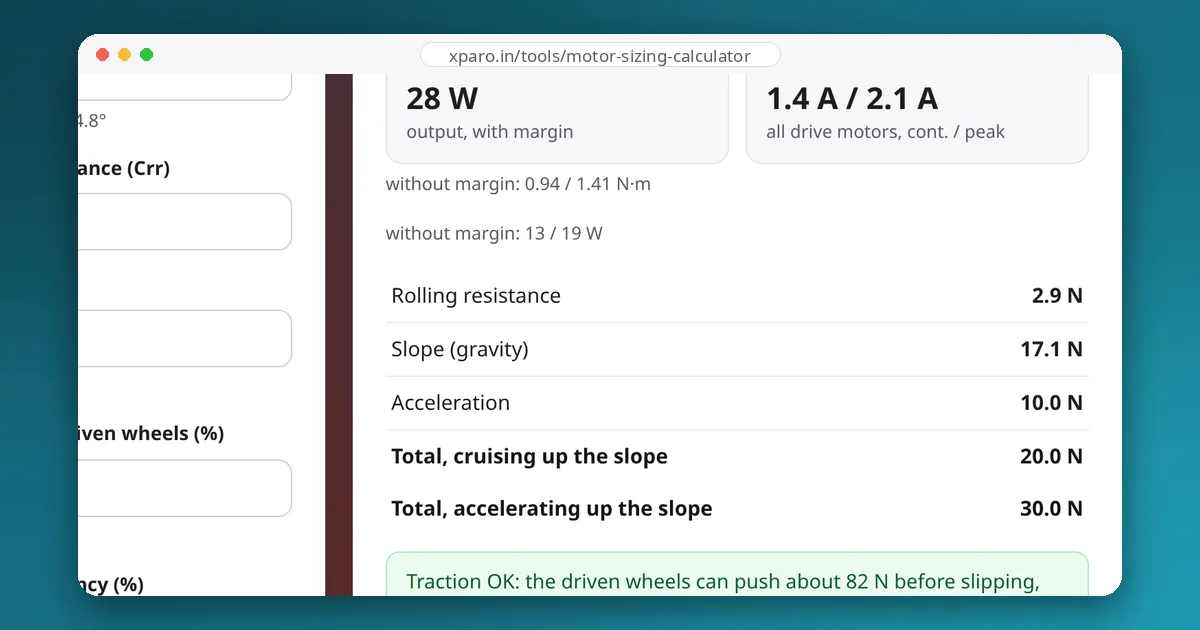
- Rolling resistance: 0.015 × 20 × 9.81 × cos 5° = 2.9 N. Slope: 20 × 9.81 × sin 5° = 17.1 N. Acceleration: 20 × 0.5 = 10 N.
- Per motor, continuous: (2.9 + 17.1) ÷ 2 × 0.075 m ÷ 0.8 = 0.94 N·m, or 1.41 N·m with the safety factor. Peak: 1.41 N·m without margin, 2.11 N·m with it.
- Wheel speed: 1 ÷ (π × 0.15) × 60 = 127 RPM. Output power: about 19 W continuous and 28 W peak per motor, with margin.
Notice that the 5° ramp needs six times more force than rolling on flat concrete. On mobile robots, slopes and acceleration usually decide the motor, not top speed on the flat.
Common mistakes
- Sizing at stall torque. Stall torque is a short-term limit that draws the most current and heats the motor fastest. Brushed gearmotors should run at or below their rated torque continuously.
- Forgetting traction. More torque does not help if the tyres slip. The traction check compares the force you need with what the driven wheels can grip.
- Ignoring voltage sag. A motor's no-load speed scales with voltage. If your battery sags from 25 V to 21 V under load, so does your top speed.
- Leaving no margin. Real friction, bearing drag and payload creep are always higher than estimates. A safety factor of 1.5 to 2 is normal for hobby and research robots.