Wheels look like the simplest part of a mobile robot, but their size, tread and type affect almost everything else: the motor torque needed, the top speed, whether the robot gets over a door threshold, how well it grips a ramp and how accurate its odometry is. This guide goes through the choices and their trade-offs.
Diameter: a lever between torque and speed
The wheel is the last lever in the drivetrain. The force a wheel pushes with is the motor torque divided by its radius, and its ground speed is its rotation rate times its circumference:
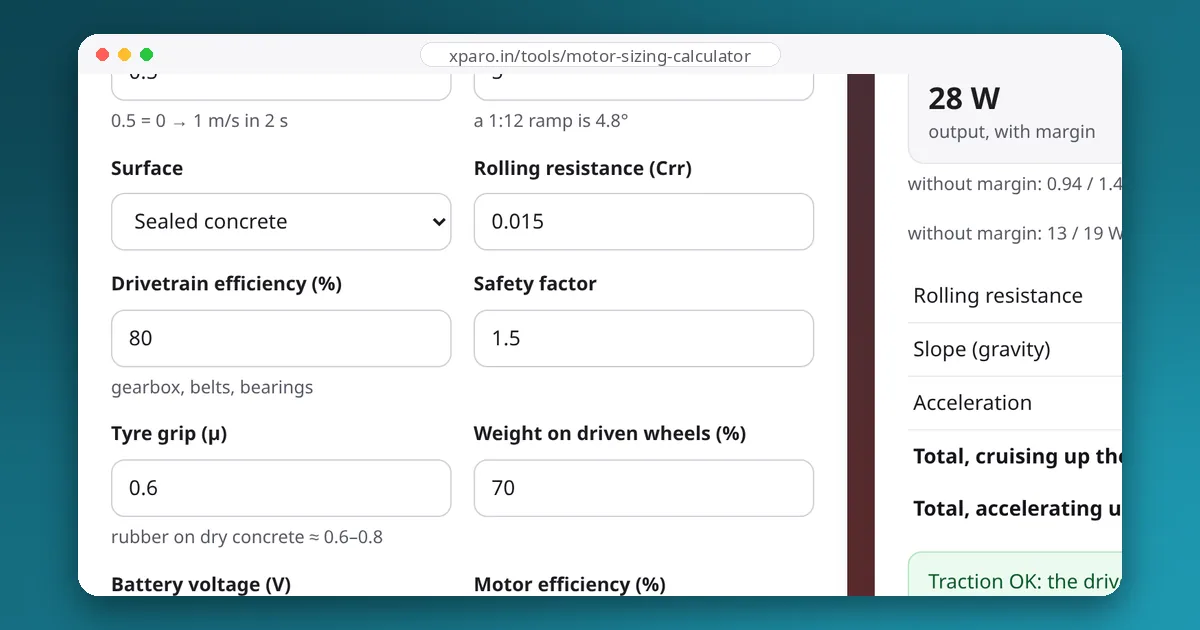
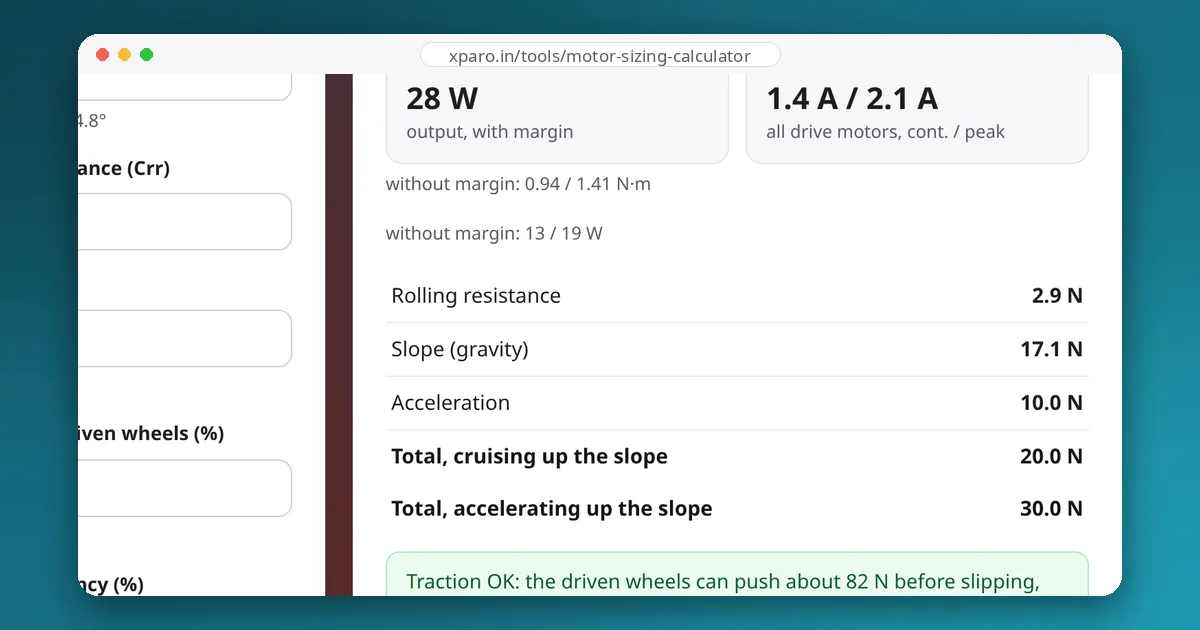
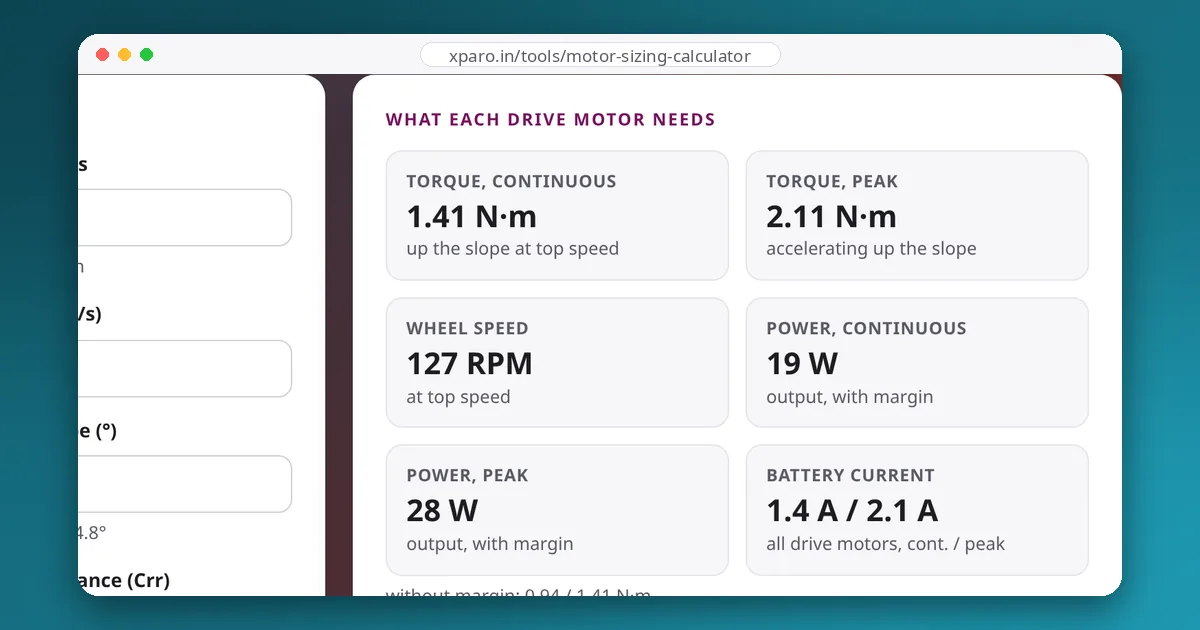
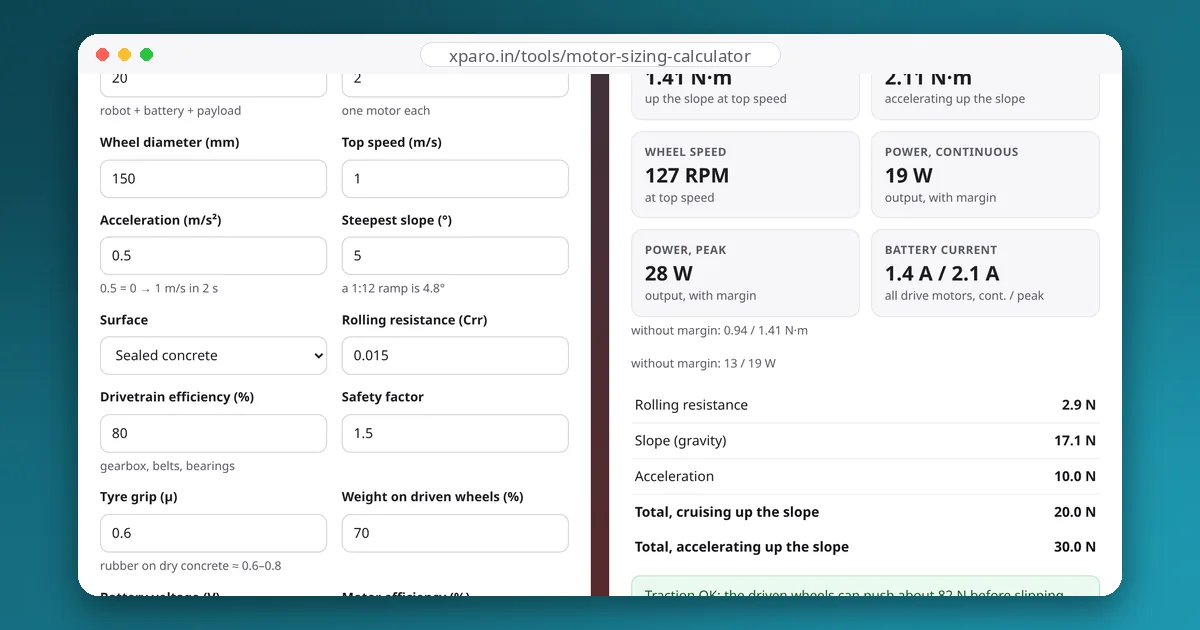
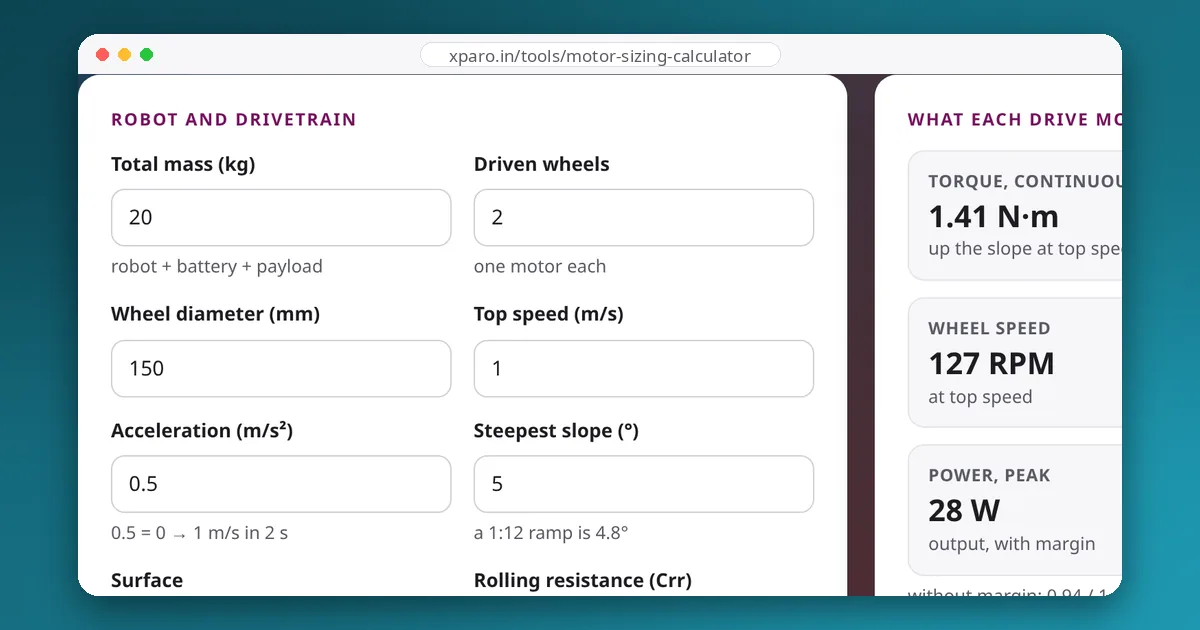
For the 45 kg robot from our motor sizing guide, climbing its 6° ramp needs about 26 N of push per driven wheel. Here is what that means for different wheel sizes, at 80 % drivetrain efficiency and a top speed of 1.5 m/s:
| Wheel diameter | Torque per wheel on the ramp | Wheel speed at 1.5 m/s |
|---|---|---|
| 100 mm | 1.65 N·m | 286 RPM |
| 150 mm | 2.47 N·m | 191 RPM |
| 200 mm | 3.30 N·m | 143 RPM |
| 250 mm | 4.12 N·m | 115 RPM |
The power is the same in every row; the wheel only changes how it is split between torque and speed, exactly as a gear ratio would. So choose diameter mainly for ground clearance and obstacles, and then pick the gear ratio to suit it, using our guide to gear ratios or the sizing calculator.
Obstacles and clearance
Larger wheels roll over bumps, cables, door thresholds and expansion joints that stop small ones, because the edge meets the wheel lower down on its curve. Casters are usually the weak point: a small caster wheel catches on a threshold that the drive wheels cross easily, so size casters generously too. Measure the tallest obstacle the robot must cross, then test a wheel against it under load; the answer depends on tyre material and traction as well as diameter.
Tyre material and traction
| Tread | Grip | Rolling resistance | Good for |
|---|---|---|---|
| Soft rubber | high | moderate | Ramps, polished floors, outdoor pavement |
| Polyurethane (PU) | moderate | low | Indoor logistics robots; quiet, hard-wearing, no marks |
| Pneumatic | good | low on smooth ground, absorbs bumps | Outdoor robots and rough ground |
| Hard plastic | low | very low | Light robots on clean, flat floors only |
Grip sets the ceiling on how hard the robot can push, whatever its motors can do, as explained in our guide to forces on a wheeled robot. Dust, water and polished concrete all cut it. Wider tyres spread the load and help on soft ground, but on skid-steer robots they increase the scrubbing force when turning.
Odometry: the wheel is also a sensor
A differential-drive robot estimates its motion from wheel rotation, so the effective wheel radius is a measurement constant. Anything that changes it causes odometry error:
- Pneumatic tyres change radius with pressure and load.
- Soft treads compress under weight, so the effective radius is smaller than the nominal one.
- Wear slowly shrinks the radius over months.
- Slip on smooth floors, ramps and during hard acceleration means the wheel turns without the robot moving the full distance.
Hard, narrow tyres give the most consistent odometry. Whatever you choose, calibrate the effective radius on the real robot, as described in calibrating wheel radius and separation.
Special wheel types
- Omni wheels have rollers around the rim so they can slide sideways. Three or four of them make a holonomic robot that can move in any direction. They have more rolling resistance, struggle with obstacles, and give poorer odometry.
- Mecanum wheels have rollers at 45° and allow sideways motion with four wheels in a rectangle. They need all four wheels on the ground, a flat floor, and they are inefficient and slip-prone.
- Casters carry weight on differential-drive robots. Swivel casters can "shimmy" at speed and push the robot sideways when it reverses; ball casters are simple but dislike dirt and thresholds.
- Tracks spread the load for soft ground and stairs, at the cost of efficiency, turning effort and odometry.
A quick decision list
- Pick the diameter for the obstacles and ground clearance you need.
- Pick the tread for the floor: PU indoors, rubber for ramps and grip, pneumatic outdoors.
- Choose the gear ratio to match the diameter, top speed and torque.
- Keep weight on the driven wheels, especially on ramps.
- Calibrate the effective radius on the real robot.