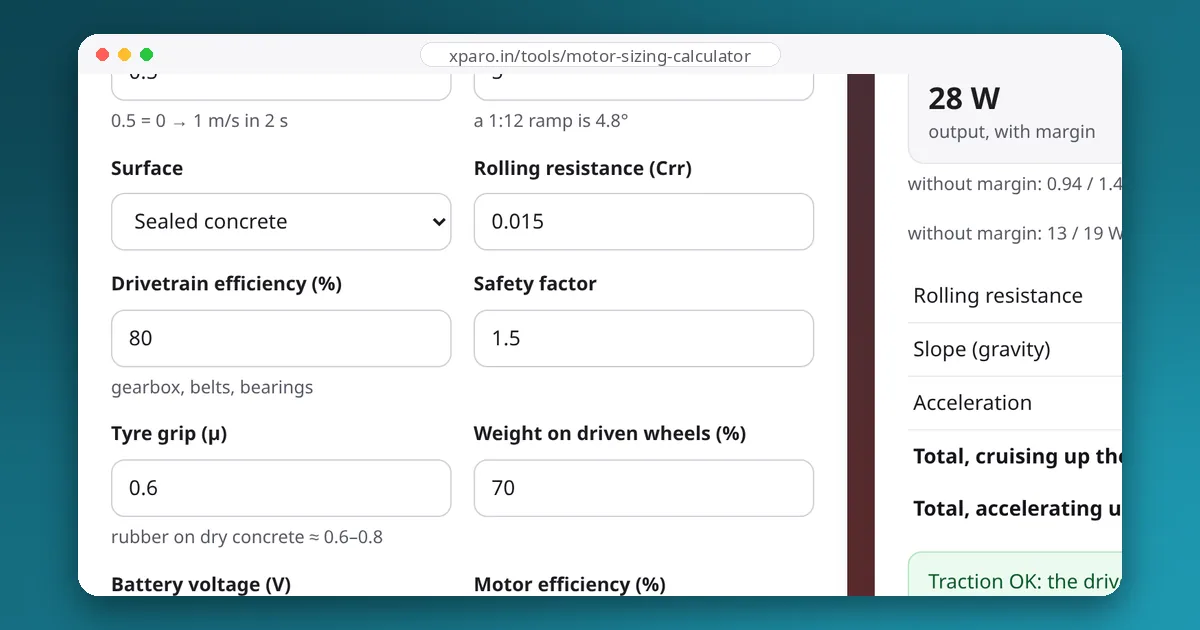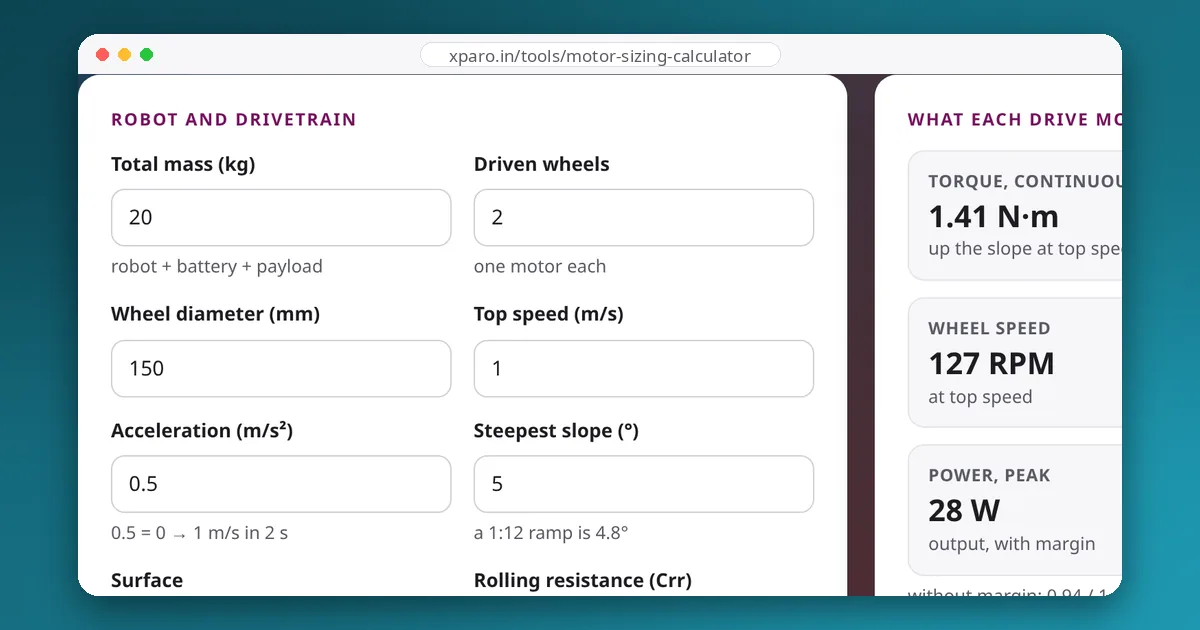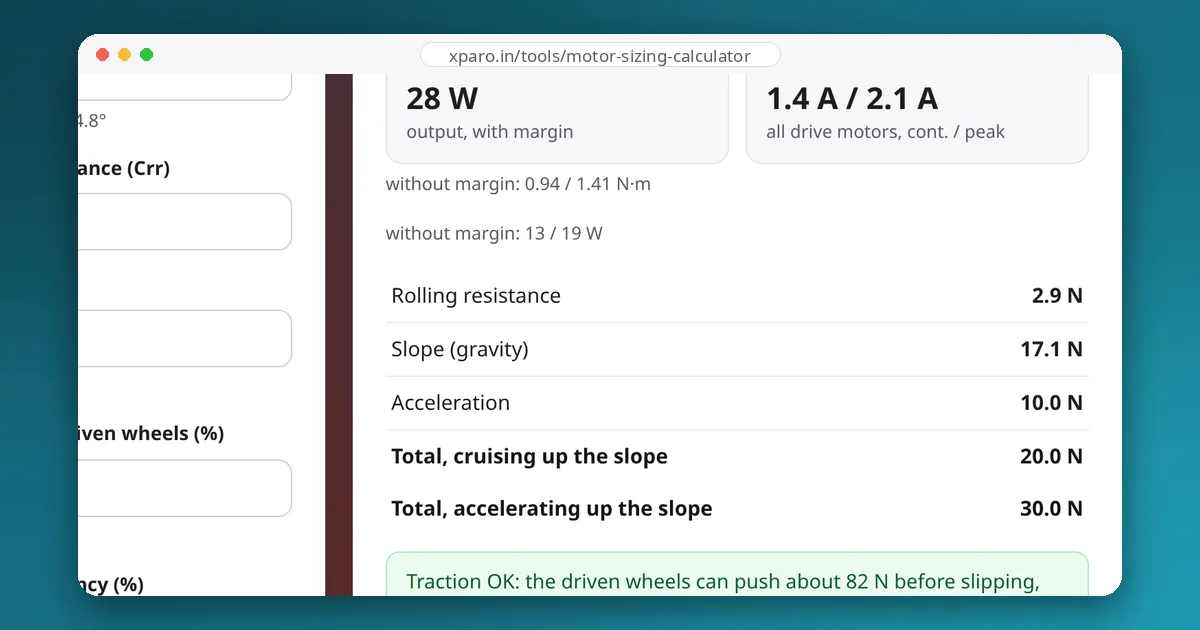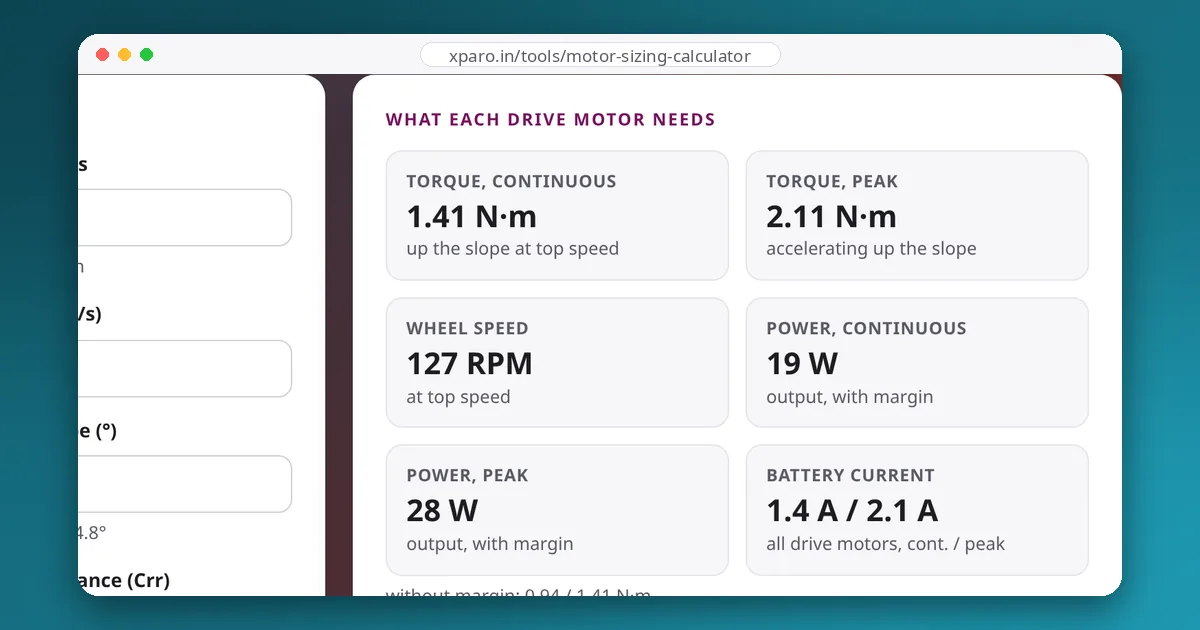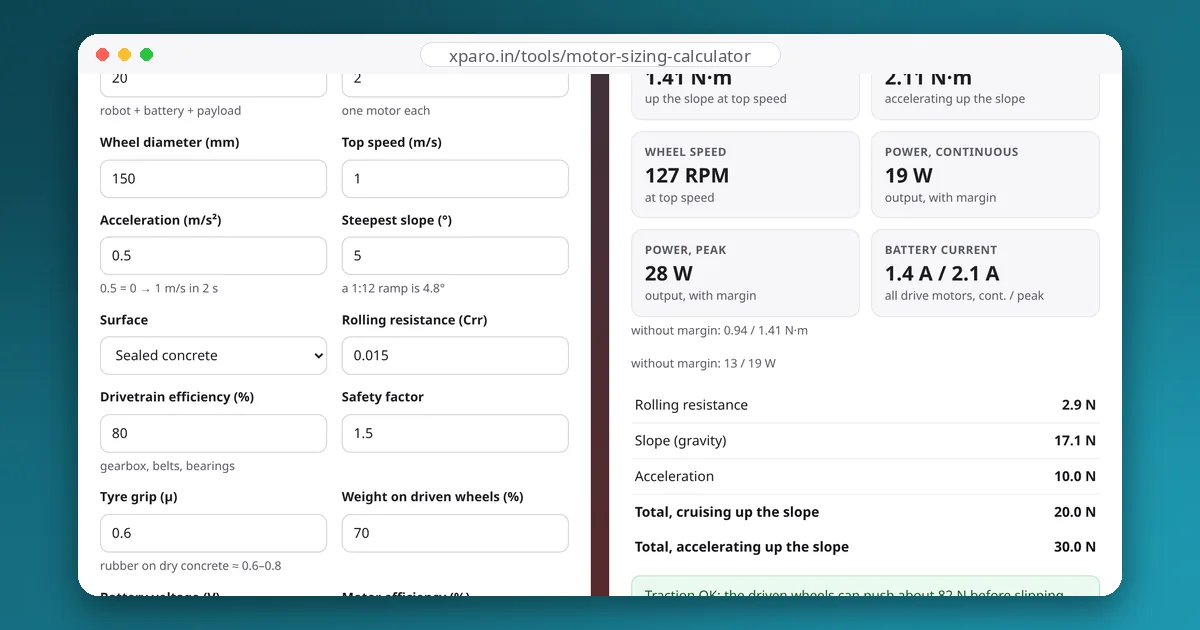
Undersized drive motors give you a robot that stalls on the first ramp; oversized ones waste money, weight and battery. Sizing them properly takes four quantities, a few lines of physics and one honest question about how your robot will really be used. This guide works through a complete example, a 45 kg delivery robot, using the same method as our Motor & Wheel Sizing Calculator.
The requirements
| Quantity | Value |
|---|---|
| Total mass (robot, battery, payload) | 45 kg |
| Driven wheels | 2 (plus casters), one motor each |
| Wheel diameter | 200 mm (radius 0.1 m) |
| Top speed | 1.5 m/s |
| Acceleration | 0.6 m/s² (0 to 1.5 m/s in 2.5 s) |
| Steepest ramp | 6° |
| Surface | sealed concrete, rolling resistance 0.015 |
| Drivetrain efficiency, safety factor | 80 %, 1.5 |
Step 1: the forces
The ramp dominates: it needs seven times the force of rolling on the flat. That is typical, and it is why "how steep and how long are the ramps?" is the first question to ask. Our guide to the forces on a wheeled robot covers each term in detail.
Step 2: torque at each wheel
Divide the force between the driven wheels, multiply by the wheel radius, and divide by the drivetrain efficiency (the motor must also overcome gearbox and bearing losses):
Step 3: speed and power
At 24 V and about 75 % motor efficiency, the two motors draw roughly 5.5 A together while climbing at full speed, and about 8.3 A while accelerating up the ramp: useful numbers for battery sizing and fuses.
Step 4: the honest question about duty cycle
The calculator's "continuous" torque assumes the robot cruises up the steepest ramp at top speed indefinitely. If the building has one short ramp that takes ten seconds to climb, that is a peak, not a continuous load. The torque the motor must sustain for minutes at a time is the flat-ground figure, 0.62 N·m with margin. The ramp torque only needs to be within the motor's short-term rating.
So size against two targets: the rated (continuous) torque for what the robot does most of the time, and the short-term torque for the ramp and acceleration. Many brushed gearmotors tolerate around two to three times their rated torque for seconds to a minute, but this varies widely; the datasheet's duty-cycle or thermal data is the authority.
Step 5: check real motors
Take two 24 V gearmotors from catalogues (values at the output shaft):
| Motor A | Motor B | |
|---|---|---|
| No-load speed | 180 RPM | 220 RPM |
| Stall torque | 12 N·m | 8 N·m |
| Rated torque | 3 N·m | 2 N·m |
| Speed at 4.94 N·m (ramp, with margin) | 106 RPM | 84 RPM |
| Peak torque as a share of stall | 62 % | 93 % |
Neither reaches 143 RPM while climbing at full load, so neither can hold 1.5 m/s on the ramp. Motor B is also too close to stall at peak: it would draw nearly its stall current while accelerating up the ramp. Motor A is a reasonable choice if the robot slows down on the ramp: at 0.75 m/s the wheels need only 72 RPM, which Motor A delivers with a comfortable margin, while its 3 N·m rating covers flat-ground cruising five times over. If full speed on the ramp is essential, you need a different motor: at 143 RPM Motor A produces only about 12 × (1 − 143 ÷ 180) ≈ 2.5 N·m, half of what the ramp needs with margin. Look for roughly twice the torque at that speed, or raise the battery voltage, which raises the whole torque-speed line.
Step 6: traction
Torque is useless if the tyres slip. With rubber on concrete (μ ≈ 0.6) and 70 % of the weight on the driven wheels, they can push about 0.6 × 45 × 9.81 × cos 6° × 0.7 ≈ 184 N, comfortably more than the 80 N needed. On a wet or dusty floor, μ can halve; check the worst surface.
Summary
- List mass, wheel size, top speed, acceleration, steepest ramp and surface.
- Compute forces, then torque and speed at the wheel, and power.
- Separate what the robot does continuously from what it does briefly, and check each against the right motor rating.
- Check speed under load from the motor's torque-speed line, not its no-load speed.
- Check traction.
The calculator does steps 1 to 6 and draws the motor's torque-speed line against your operating points. To read those lines from a datasheet, see gear ratios and motor datasheets.