Every drive-motor calculation starts with one question: how hard does the robot have to push against the ground? The answer is the sum of a few forces, each with a simple formula and a few surprises. This guide goes through them one by one with numbers for a 45 kg robot, so you can see which ones matter and which you can ignore.
1. Rolling resistance
A rolling wheel and the floor both deform slightly at the contact patch, and some of that energy is lost as heat. The resulting force is proportional to the load on the wheels:
The coefficient Crr depends far more on the surface and the tyre than on anything else:
| Surface (typical tyre) | Crr, approximate | F_roll for 45 kg |
|---|---|---|
| Tile or smooth hard floor (hard rubber or PU) | 0.01 | 4.4 N |
| Sealed concrete | 0.015 | 6.6 N |
| Asphalt (pneumatic) | 0.03 | 13 N |
| Low-pile carpet | 0.05 | 22 N |
| Packed gravel | 0.08 | 35 N |
| Grass | 0.15 | 66 N |
| Loose sand | 0.25 | 110 N |
These are planning values; real numbers vary with tyre size, hardness and inflation. The lesson is the spread: the same robot needs over three times the force on carpet as on concrete, and many times more outdoors. Size for the worst surface the robot will meet, and if you can, measure: tow the robot slowly with a spring scale or luggage scale and read the force.
2. Gravity on a slope
| Slope | Gradient | Force for 45 kg |
|---|---|---|
| 2° | about 1 in 29 | 15.4 N |
| 4.8° | 1 in 12 (a common accessibility ramp limit) | 36.9 N |
| 6° | about 1 in 9.5 | 46.1 N |
| 10° | about 1 in 5.7 | 76.7 N |
| 15° | about 1 in 3.7 | 114.3 N |
On concrete, even a gentle 5° ramp needs about six times the force of rolling on the flat. Slopes are usually the single biggest factor in motor size, and also in braking: going down, the motors must hold the robot back, so check that your drivers handle regenerated energy and that the robot cannot run away if power is lost.
3. Acceleration
Accelerating 45 kg at 0.6 m/s² takes 27 N. Gentle acceleration is cheap: halving it halves this force, which often lets you use smaller motors and makes the robot easier to control and kinder to its payload. See velocity and acceleration limits for how to enforce it.
The hidden mass of rotating parts
Wheels, gears and especially motor rotors must be spun up too. A gearbox multiplies the rotor's inertia by the square of the ratio as felt at the wheel. A small rotor of 1 × 10⁻⁵ kg·m² behind a 30:1 gearbox looks like 0.009 kg·m² at the wheel, which on a 0.1 m radius wheel acts like an extra 0.9 kg per wheel. For most gearmotor robots, adding 5 to 10 % to the mass in the acceleration term covers this.
4. Aerodynamic drag
With air density about 1.2 kg/m³, a boxy robot (Cd ≈ 1) with 0.3 m² of frontal area at 1.5 m/s feels about 0.4 N. Below roughly walking speed, drag is negligible next to rolling resistance. It grows with the square of speed, so it starts to matter for fast outdoor robots and in strong wind.
5. Traction: the limit on all of the above
The driven wheels can only push as hard as friction allows:
Rubber on dry concrete gives μ around 0.6 to 0.8; on wet, dusty or polished floors it can fall to half that. If the forces above add up to more than F_max, the wheels spin, however strong the motors are. Robots with two driven wheels and casters carry part of their weight on the casters, which reduces F_max; keep the centre of mass over the driven wheels, especially on ramps, where weight shifts toward the rear.
Putting it together
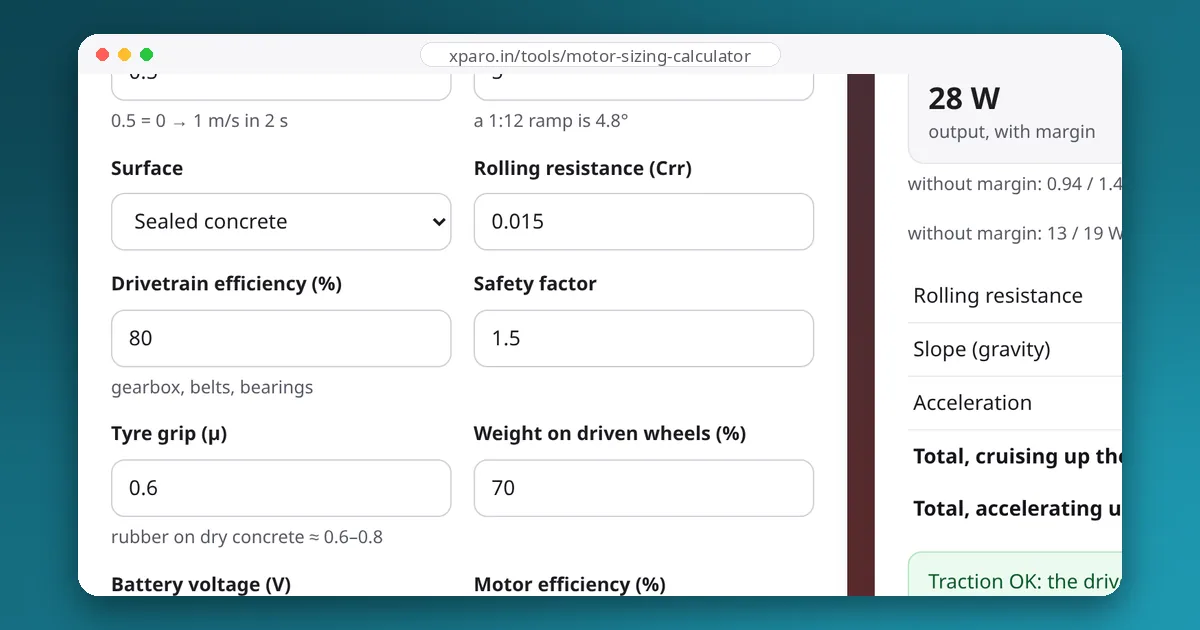
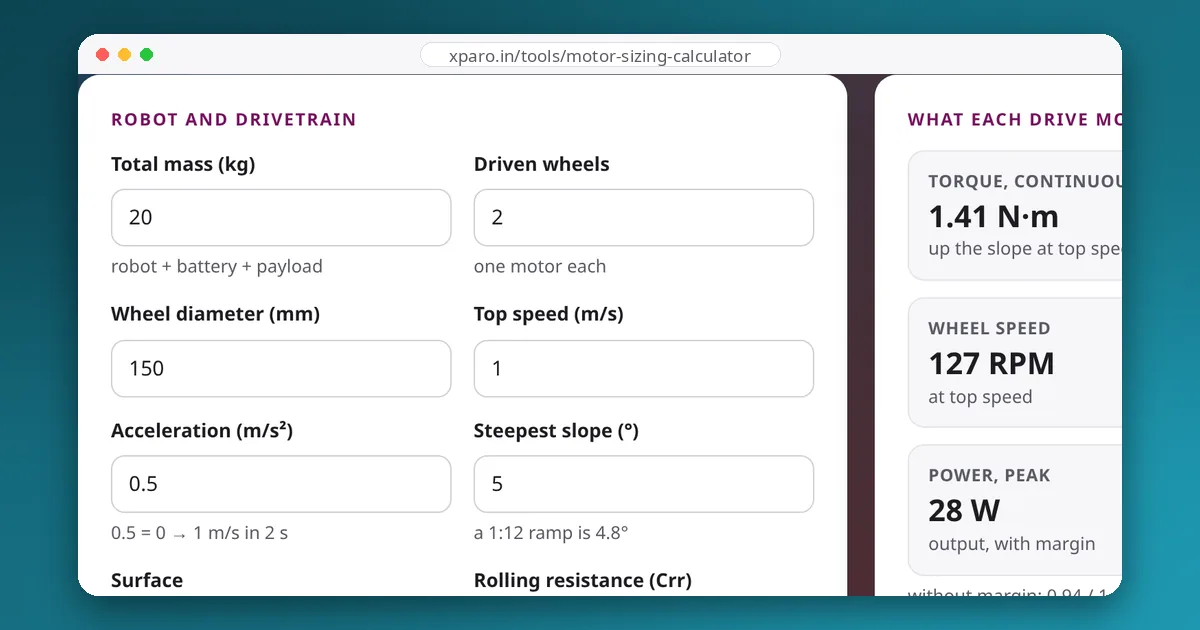
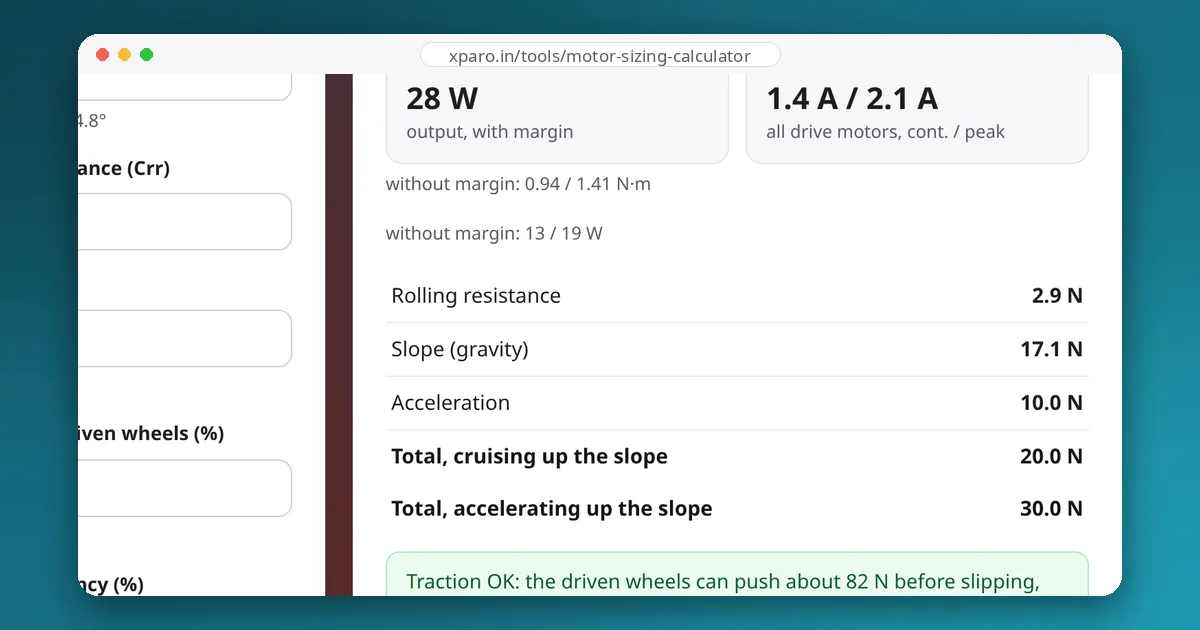
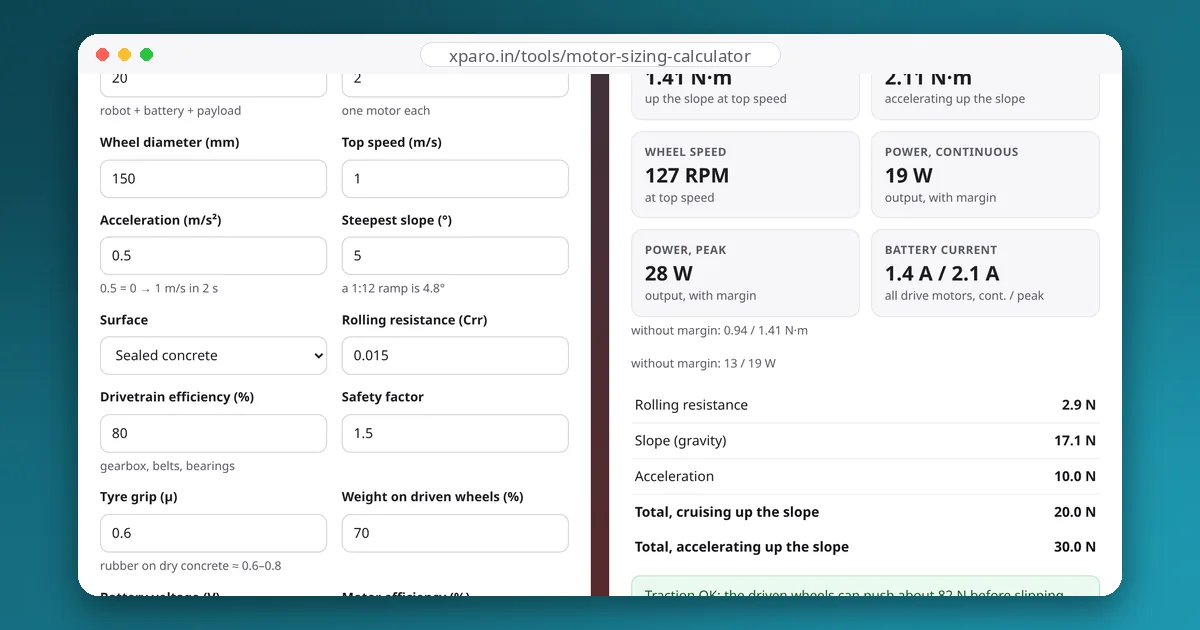
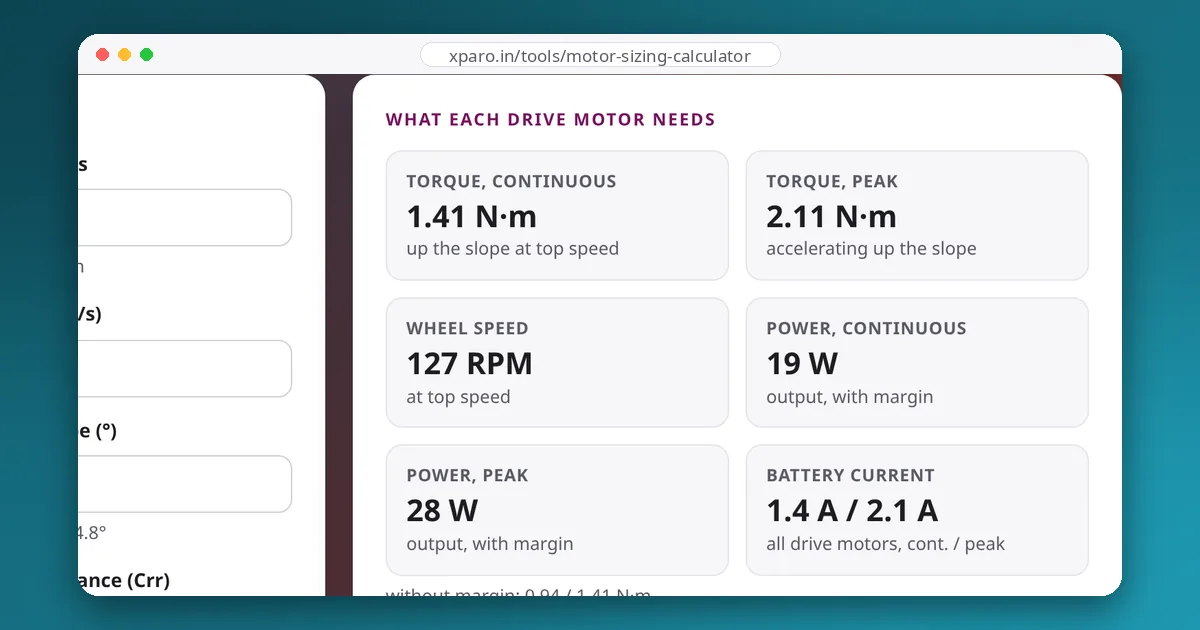
For our 45 kg robot on a 6° concrete ramp, that is 52.7 N cruising and 79.7 N accelerating, against a traction limit of about 184 N. Turning those forces into motor torque, speed and power is the next step, covered in how to size motors for a mobile robot; the Motor & Wheel Sizing Calculator does all of it at once.
One more force for skid-steer robots
Robots that turn by skidding, such as four-wheeled or tracked skid-steer platforms, must drag their wheels sideways across the floor to turn. That scrubbing force is often larger than everything above, especially on grippy surfaces. Size skid-steer motors for turning on the spot as well as for driving straight, and test on the real floor.