How to Calculate Your Robot's Battery Runtime (With a Worked Example)
Read the post →
Robotics · October 2026
Estimate how long a robot runs on one charge, before you buy the battery.
 By pankaj · 0 robots
About
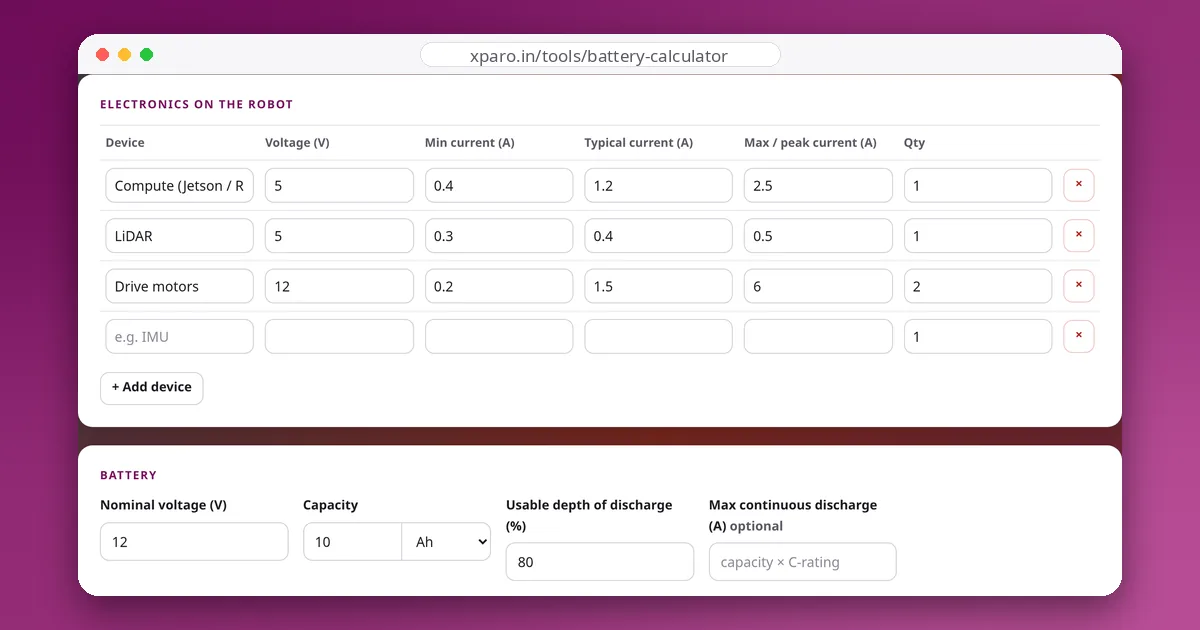
Every mobile robot eventually stops in the middle of a test because the battery ran out sooner than expected. The Battery Backup Calculator is a small tool we built so that question gets answered before the battery is bought, not after.
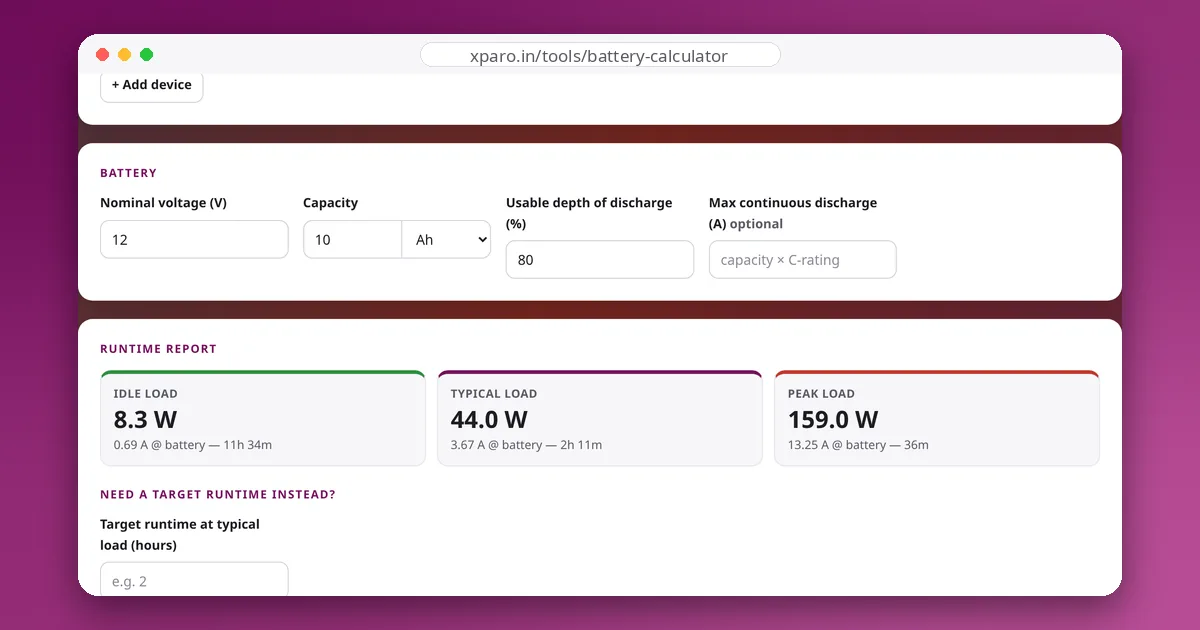
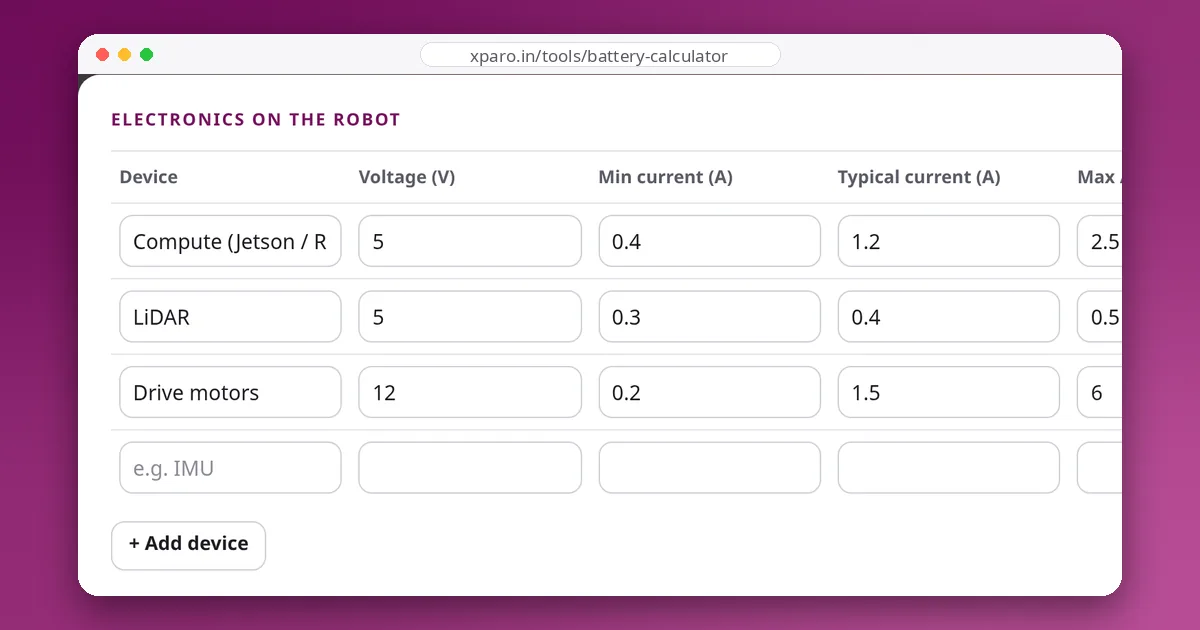
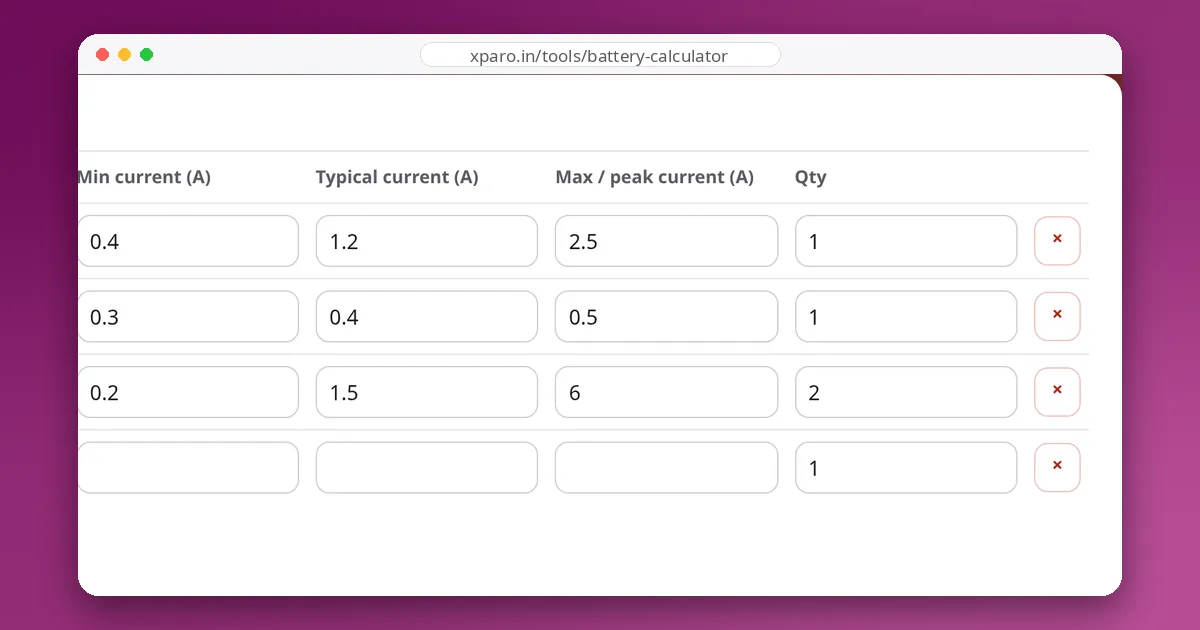
You list what runs on the robot (computer, sensors, motor drivers, motors, lights) with the voltage each device uses and three currents: idle, typical and peak. You describe the battery pack. The calculator converts everything to watts, works out the current drawn from the pack, and reports the runtime for each case, together with a warning when the peak draw is more than the pack is rated to deliver.
Power is the one quantity you can add up safely across devices at different voltages, because a DC-DC converter passes power through (minus a little loss) while changing voltage and current. The calculator sums the power of all devices, divides by the pack voltage to get the pack current, and divides the usable charge (capacity times depth of discharge) by that current to get hours. The tool page shows every formula and a fully worked example.
Students and makers building their first rover, research teams sizing a pack for a new platform, and anyone who wants a quick sanity check before ordering parts. It runs in the browser, needs no account, and nothing you type leaves your computer.
Open the Battery Backup Calculator, then read the guides below for the details: real current measurement, C-ratings, battery chemistries and safety.
Gallery
Team
The team that builds, runs and answers for this project on XPARO.
Updates
Read the post →
Read the post →
Read the post →
Read the post →
Read the post →
FAQ
Yes. It is free, needs no account, and runs entirely in your browser. Nothing you type is sent to our server.
They are as accurate as the current figures you enter. Use measured currents where you can, keep the depth-of-discharge setting realistic for your chemistry, and treat the result as a planning estimate with 10 to 20 percent margin.
Yes. Every device is converted to watts first, so 5 V computers, 12 V motors and 24 V actuators can share one battery in the same calculation. Converter losses are not included, so add 10 to 15 percent for DC-DC converters.
The guides on this page walk through the maths step by step, explain C-ratings and battery chemistries, and show how to measure real current draw.
Contact
Questions, ideas, or want to work with the team? Your message goes straight to the Battery Backup Calculator team on XPARO. Add your email if you'd like a reply.