The battery is the most dangerous component on most robots. A lithium pack stores enough energy to start a fire, and a short circuit can melt wires in seconds. None of this is a reason to avoid lithium batteries; it is a reason to treat them with a few simple habits. This guide collects those habits for charging, storage, wiring and protection.
This is general guidance for hobby and research robots. Always follow the instructions of your battery, charger and BMS manufacturer, and local regulations, which take priority over anything here.
Charging
- Use a charger made for the chemistry. Lithium-ion and LiPo cells charge to 4.2 V per cell, LiFePO4 to about 3.6 V, and lead-acid needs a completely different profile. The wrong charger is the most common cause of serious battery accidents.
- Balance multi-cell packs. A series pack is only as healthy as its weakest cell. Packs without a BMS must be charged through their balance lead; packs with a BMS rely on its balancing.
- Charge at 1C or less unless the datasheet allows more. For a 5000 mAh pack, that is 5 A or less.
- Mind the temperature. Do not charge lithium cells below about 0 °C or above about 45 °C (check your cell's limits). Let a pack cool after a hard run before charging it.
- Charge where a fire would not spread. Use a fire-resistant surface or a battery bag or box, away from anything flammable, and don't leave charging unattended.
Storage
Lithium packs age fastest when stored full or hot. For anything longer than a few days, store them at partial charge in a cool place:
| Chemistry | Storage charge | Notes |
|---|---|---|
| LiPo, Li-ion | about 3.8 V per cell (roughly 40–60 %) | Most hobby chargers have a "storage" mode that does this. |
| LiFePO4 | around 50 % | The flat voltage curve makes voltage a poor guide; use the BMS or charger's state of charge. |
| Lead-acid | full | Lead-acid batteries sulphate when stored partly discharged; top them up regularly. |
Never let lithium cells sit fully discharged. Below about 2.5 to 3.0 V per cell (depending on chemistry) they can be damaged permanently, and a cell that has been driven very low should not be recharged.
Protection on the robot
A battery management system
For any lithium pack with more than one cell in series, a BMS is strongly recommended. It disconnects the pack on over-voltage, under-voltage, over-current and short circuit, balances the cells, and on better boards cuts off outside a safe temperature range. Check its continuous current rating against your robot's peaks: an undersized BMS trips during normal driving.
A fuse close to the battery
A fuse protects the wiring from burning if something shorts. Put it in the positive lead as close to the battery as possible, so that almost all of the wiring is downstream of it. Choose a rating above your normal maximum current (so it does not blow during a hard start) but below what the wire can carry. Use fuses rated for DC at your pack voltage; automotive blade fuses suit low-voltage robots up to a few tens of amps.
A real power switch and emergency stop
Fit a main switch or contactor rated for the full current, so you can isolate the battery without unplugging connectors. Robots that move with force should also have an emergency stop that cuts motor power in hardware, not just a software command.
Wire and connectors
Wire that is too thin wastes power, drops voltage and in a fault becomes a heating element. The table below is a conservative guide for short power runs inside a robot chassis with typical PVC or silicone insulation. Long runs, bundled wires and hot enclosures need thicker wire; check the wire maker's rating.
| Wire | Approx. area | Resistance | Conservative continuous current |
|---|---|---|---|
| 22 AWG | 0.33 mm² | 53 mΩ/m | about 3 A |
| 20 AWG | 0.52 mm² | 33 mΩ/m | about 5 A |
| 18 AWG | 0.82 mm² | 21 mΩ/m | about 7–10 A |
| 16 AWG | 1.3 mm² | 13 mΩ/m | about 10–13 A |
| 14 AWG | 2.1 mm² | 8.3 mΩ/m | about 15–20 A |
| 12 AWG | 3.3 mm² | 5.2 mΩ/m | about 20–30 A |
| 10 AWG | 5.3 mm² | 3.3 mΩ/m | about 30–40 A |
Remember the voltage drop: current flows out and back, so a 1 m cable run is 2 m of wire. At 15 A through 2 m of 16 AWG, the drop is about 15 × 0.026 = 0.39 V and the wire dissipates almost 6 W.
For connectors, use types made for power with a continuous rating above your fuse. Ratings are often lower than the number in the product name suggests, so read the connector maker's datasheet. Make sure connectors are polarised so they cannot be plugged in backwards, and keep the battery side female so its contacts cannot touch anything.
Mechanical protection
- Mount the pack where a collision cannot crush or puncture it, and secure it so it cannot shift.
- Protect wires from sharp edges and moving parts, and add strain relief at connectors and solder joints.
- Insulate exposed terminals and balance leads. A dropped spanner across a battery terminal is a classic way to start a fire.
Warning signs
- Swelling. A puffy LiPo has generated gas inside and must be retired. Do not charge it, do not puncture it.
- Heat. A pack that gets uncomfortably hot during normal use is overloaded or damaged.
- Imbalance. Cells drifting more than a few tens of millivolts apart after balancing point to a failing cell.
- Damage. Any pack that has been crushed, punctured or soaked should be removed from service.
When things go wrong
If a pack starts to smoke, hiss or swell rapidly, get people away first. Lithium battery fires produce toxic gases and can reignite after appearing to go out. Call emergency services for anything beyond a very small pack. Decide in advance where you would move a failing pack, if it can be done safely with tools rather than hands, and keep the area clear.
Disposal and transport
Take retired packs to a battery recycling point; never put lithium batteries in household waste. Discharge them to a low state of charge first if your recycler asks you to, and tape over the terminals. For shipping and air travel, lithium batteries are regulated as dangerous goods; check the carrier's rules before sending or flying with a robot.
A short checklist
- Correct charger, balance charging, 1C or less, never unattended.
- Storage at partial charge, never fully discharged.
- BMS rated for your peaks, fuse at the battery, real power switch.
- Wire sized for the current and voltage drop, polarised connectors.
- Pack protected from crushing, puncture and vibration.
- Retire packs that swell, overheat or are damaged.
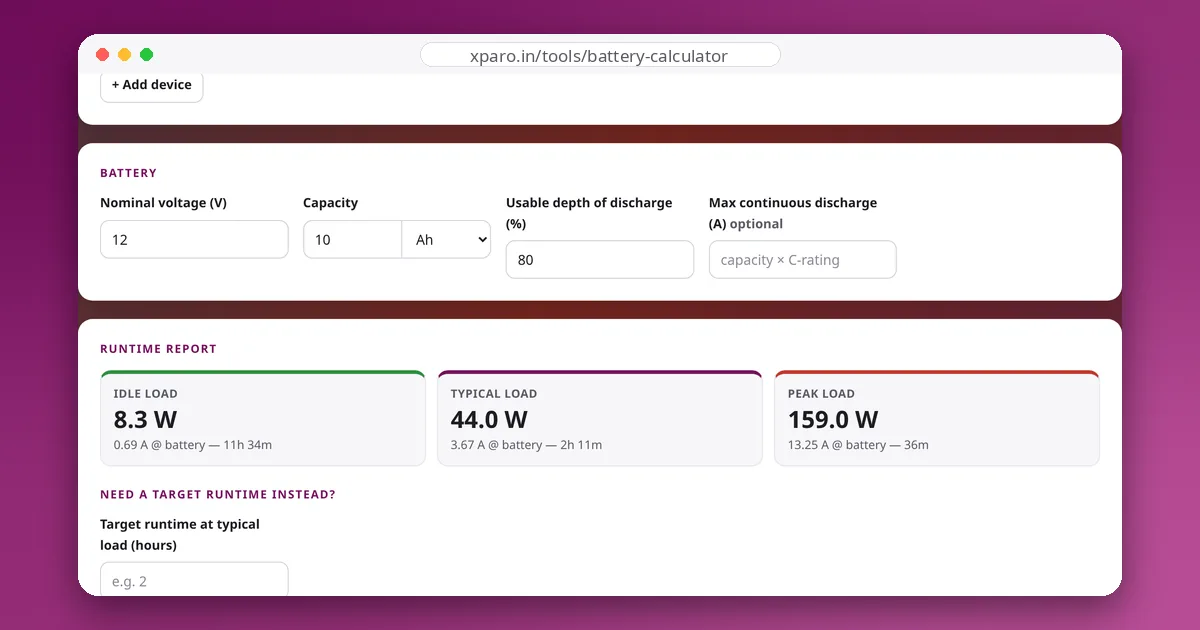
Sizing the pack itself is covered in our runtime guide, and choosing the chemistry in LiPo vs Li-ion vs LiFePO4.