Every robotics workbench ends up with a pile of loose resistors. Reading their colour bands quickly is a small skill that saves a lot of time, and understanding where the odd-looking standard values come from makes choosing resistors easier. This guide covers 4-, 5- and 6-band codes, tolerance, temperature coefficient and the E-series.
The colours
| Colour | Digit | Multiplier | Tolerance | Temp. coefficient |
|---|---|---|---|---|
| Black | 0 | × 1 | 250 ppm/K | |
| Brown | 1 | × 10 | ±1 % | 100 ppm/K |
| Red | 2 | × 100 | ±2 % | 50 ppm/K |
| Orange | 3 | × 1 k | 15 ppm/K | |
| Yellow | 4 | × 10 k | 25 ppm/K | |
| Green | 5 | × 100 k | ±0.5 % | 20 ppm/K |
| Blue | 6 | × 1 M | ±0.25 % | 10 ppm/K |
| Violet | 7 | × 10 M | ±0.1 % | 5 ppm/K |
| Grey | 8 | × 100 M | ±0.05 % | 1 ppm/K |
| White | 9 | × 1 G | ||
| Gold | × 0.1 | ±5 % | ||
| Silver | × 0.01 | ±10 % | ||
| (none) | ±20 % |
A handy mnemonic for the digit order is "Better Be Right Or Your Great Big Venture Goes Wrong": black, brown, red, orange, yellow, green, blue, violet, grey, white.
4-band resistors
Two digits, a multiplier and a tolerance. These are the common ±5 % carbon-film parts.
5-band resistors
Three digits, a multiplier and a tolerance, used for precision (usually ±1 %) metal-film parts.
6-band resistors
A 5-band code plus a sixth band for the temperature coefficient: how much the resistance changes per degree, in parts per million per kelvin. A 100 ppm/K (brown) resistor changes by 0.01 % per °C, so 0.5 % over a 50 °C swing. That matters in precision circuits, such as a current shunt or a reference divider in a robot that works outdoors.
Which end is band one?
Orientation is the most common source of misreadings. Clues, in order of reliability:
- The tolerance band is often set apart by a slightly wider gap. Hold the resistor so the gap is on the right.
- Gold and silver are never first-digit colours, so a gold or silver band marks the right-hand end.
- The first band is usually closer to the end of the body.
- If both readings give plausible values, the one that lands on a standard E-series value (below) is almost always right.
And when in doubt, measure it. A multimeter settles the question in two seconds, as long as the resistor is out of the circuit.
Why resistors come in odd values: the E-series
Resistors are not made in every value. Manufacturers make values spaced so that, with the tolerance, every possible resistance is covered. Each series divides one decade into a fixed number of roughly logarithmic steps:
| Series | Values per decade | Typical tolerance | Values |
|---|---|---|---|
| E6 | 6 | ±20 % | 10, 15, 22, 33, 47, 68 |
| E12 | 12 | ±10 % | 10, 12, 15, 18, 22, 27, 33, 39, 47, 56, 68, 82 |
| E24 | 24 | ±5 % | E12 plus 11, 13, 16, 20, 24, 30, 36, 43, 51, 62, 75, 91 |
| E96 | 96 | ±1 % | 100, 102, 105, 107, 110, 113 … 953, 976 |
So a "10 kΩ, 22 kΩ, 47 kΩ" parts kit is not arbitrary: those are E6 values. When a calculation asks for 18.3 kΩ, pick the nearest value in the series you stock (18 kΩ in E12) and check that the result is still acceptable, or combine two resistors in series.
Surface-mount resistors
Tiny SMD resistors use printed number codes instead of colours:
- Three digits (5 % parts): two digits and a multiplier.
472is 47 × 10² = 4.7 kΩ;100is 10 Ω (not 100 Ω). - Four digits (1 % parts): three digits and a multiplier.
4701is 470 × 10 = 4.7 kΩ. - R for the decimal point:
4R7is 4.7 Ω,R010is 0.010 Ω (a current shunt). - EIA-96 (1 % parts in small packages): two digits index the E96 table and a letter gives the multiplier;
01Cis 100 × 100 = 10 kΩ.
A part marked 0 or 000, or a through-hole resistor with a single black band, is a zero-ohm link, used as a jumper.
Values you will reach for most on a robot
| Value | 4-band colours | Typical use |
|---|---|---|
| 220 Ω / 330 Ω | red red brown / orange orange brown | LED current limiting from 3.3 V or 5 V |
| 1 kΩ | brown black red | Base resistor for a small transistor, series protection for inputs |
| 4.7 kΩ | yellow violet red | I2C pull-ups, one-wire sensor pull-ups |
| 10 kΩ | brown black orange | Button pull-ups and pull-downs, MOSFET gate pull-downs |
| 100 kΩ | brown black yellow | Top resistor of a battery voltage divider |
Power rating
The colour code does not show the power rating; size does. Common through-hole carbon-film resistors are 1/4 W (about 6 mm long) or 1/2 W. Calculate the power with P = I²R and choose a part rated for at least twice that; the Ohm's law guide shows several examples, including current shunts that need several watts.
Use the calculator both ways
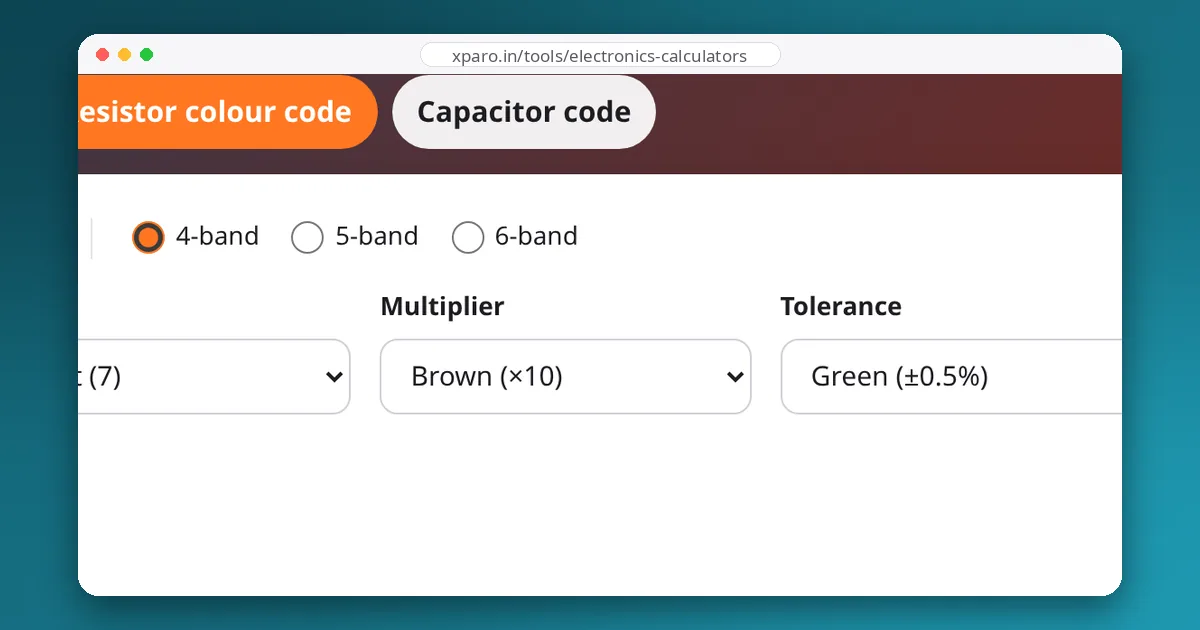
The resistor colour code calculator decodes 4-, 5- and 6-band resistors and draws the bands so you can compare them with the part in your hand. Switch it to "value → bands" and type a value such as 4.7k to see which colours to look for when sorting a parts drawer.